
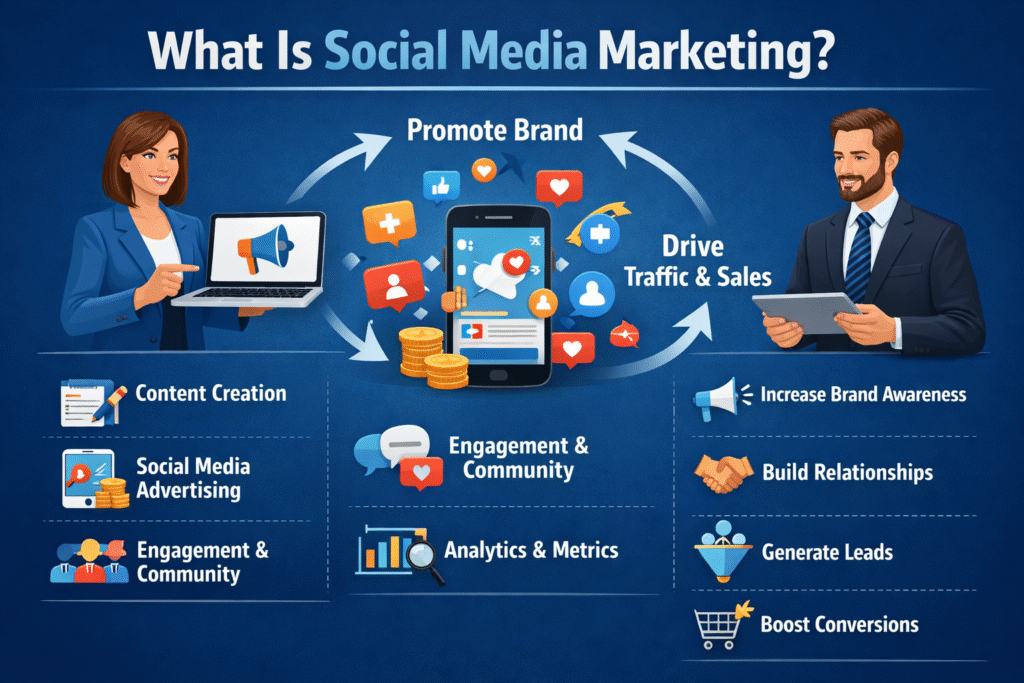
Social media marketing is a powerful digital marketing strategy that leverages social media platforms to connect with audiences, build brand awareness, drive website traffic, and increase sales. In today’s interconnected digital world, social media marketing has evolved from a nice-to-have option to an essential business strategy. With over 4.9 billion people using social media globally, these platforms offer unprecedented opportunities to reach, engage, and convert your target audience. At Classify Skill Education, we help businesses and marketing professionals master social media marketing strategies that create authentic connections, build communities, and drive measurable business results in an increasingly competitive digital landscape.
Understanding How Social Media Marketing Works
Social media marketing involves creating and sharing content on social media platforms like Facebook, Instagram, Twitter, LinkedIn, TikTok, YouTube, and Pinterest to achieve your marketing goals. Unlike traditional one-way advertising, social media marketing enables two-way communication between brands and customers, creating opportunities for dialogue, relationship building, and community development.
The fundamental power of social media marketing lies in its ability to facilitate authentic human connections at scale. When done correctly, it transforms businesses from faceless entities into relatable brands with personality, values, and voice. This humanization builds trust, and trust drives purchasing decisions. People buy from brands they know, like, and trust—social media provides the platform to cultivate all three.
Social media marketing operates through both organic and paid strategies. Organic social media involves posting content without paying for promotion, relying on followers, shares, and algorithmic distribution to reach audiences. While organic reach has declined on most platforms as they prioritize paid content, it remains essential for community building, customer service, and establishing authentic brand presence.
Paid social media advertising uses platform advertising systems to promote content to targeted audiences beyond your followers. Social media ads offer sophisticated targeting options based on demographics, interests, behaviors, and even lookalike audiences similar to your existing customers. This precision targeting makes social ads highly effective for reaching ideal customers cost-effectively.
Successful social media marketing integrates both organic and paid strategies. Organic content builds community and engagement while paid promotion amplifies reach and drives specific business objectives. The combination creates comprehensive programs that maximize both short-term results and long-term brand building.
Exploring Major Social Media Platforms for Marketing
Different social media platforms serve different purposes, attract different demographics, and require different content approaches. Understanding each platform’s unique characteristics enables strategic platform selection and content optimization.

Facebook Marketing
Facebook marketing remains powerful despite recent challenges. With 2.9 billion monthly active users spanning all age groups, Facebook offers massive reach and sophisticated advertising capabilities. It excels for building communities through Groups, sharing diverse content types including text, images, videos, and live streams, and running highly targeted advertising campaigns.
Facebook’s algorithm prioritizes meaningful interactions, particularly from friends and family. For businesses, this means focusing on content that sparks conversations, encouraging comments and shares rather than passive consumption. Facebook Groups provide opportunities to build engaged communities around shared interests related to your brand.
Instagram Marketing
Instagram marketing dominates visual storytelling and influencer collaborations. With over 2 billion monthly users skewing younger (though increasingly diverse), Instagram emphasizes visual content through feed posts, Stories, Reels, and IGTV. Its shopping features make it powerful for e-commerce brands.
Instagram’s aesthetic-focused culture requires high-quality visual content. Brands succeed by maintaining cohesive visual identities, leveraging user-generated content, partnering with influencers, and using Stories for behind-the-scenes authenticity. Reels offer exceptional organic reach as Instagram prioritizes short-form video to compete with TikTok.
LinkedIn Marketing
LinkedIn marketing is essential for B2B companies and professional services. With 900 million members focused on professional networking, LinkedIn excels for thought leadership, B2B lead generation, recruitment marketing, and establishing industry authority.
LinkedIn’s professional context means content should be educational, insightful, and career-relevant. Company pages, personal profiles of executives and employees, LinkedIn articles, and industry discussions all contribute to effective LinkedIn marketing. The platform’s advertising tools enable precise targeting by job title, industry, company size, and professional interests.
Twitter Marketing
Twitter marketing excels at real-time engagement, news sharing, customer service, and participating in trending conversations. Its fast-paced, text-focused (though increasingly visual) format works well for timely updates, thought leadership through threaded insights, customer support through quick responses, and brand personality through witty, engaging content.
Twitter’s public, conversational nature makes it ideal for building brand personality and engaging directly with customers, influencers, and industry leaders. Monitoring relevant hashtags and participating authentically in conversations extends reach and builds relationships.
YouTube Marketing
YouTube marketing leverages the world’s second-largest search engine (after Google, which owns YouTube). With 2.7 billion monthly users, YouTube excels for long-form video content including tutorials and how-to videos, product reviews and demonstrations, educational content and courses, entertainment and storytelling, and vlogs and behind-the-scenes content.
YouTube’s search functionality makes it powerful for SEO-driven content discovery. Optimizing video titles, descriptions, tags, and thumbnails for search helps content get discovered. Consistent publishing schedules build subscriber bases that provide predictable viewership for new content.
At Classify Skill Education, we provide comprehensive training on all major social media platforms, teaching platform-specific strategies, content best practices, and advertising techniques that maximize results on each channel.
The Compelling Benefits of Social Media Marketing
Social media marketing delivers numerous advantages that make it essential for modern business success. These benefits work synergistically, each reinforcing the others to create comprehensive marketing impact.
Massive Brand Awareness Potential
Social media platforms provide unprecedented opportunities to increase brand awareness by putting your business in front of millions of potential customers. Every post, share, comment, and like extends your reach. Viral content can explode brand visibility overnight, though consistent, quality content typically builds awareness more reliably over time.
The social nature of these platforms means your content can be amplified through shares and recommendations, lending credibility that paid advertising alone cannot achieve. When someone’s trusted friend shares your content, it carries more weight than any advertisement.
Cost-Effective Marketing Investment
Social media marketing is remarkably cost-effective marketing compared to traditional channels. Creating social media profiles is free. Organic posting costs nothing but time. Even paid social advertising typically delivers lower cost-per-acquisition than traditional advertising channels due to precise targeting that ensures your budget reaches highly relevant audiences.
Small businesses can compete with larger competitors on social media because success depends more on creativity, authenticity, and consistency than massive budgets. A clever, well-targeted campaign from a small business can outperform expensive campaigns from major brands that don’t resonate with audiences.
Enhanced Customer Engagement
Social media marketing dramatically improves customer engagement through direct, two-way communication. Customers can comment on posts, ask questions, share feedback, and interact with your brand in ways impossible through traditional marketing. This interaction creates relationships that build loyalty and turn customers into advocates.
Responding promptly and authentically to comments, questions, and mentions shows customers you value them. This attention creates positive experiences that customers remember and share with others. Even handling complaints publicly and professionally can enhance brand reputation when done well.
Targeted Website Traffic
Strategic use of social media drives qualified website traffic. Every post can include links to relevant website content—blog posts, product pages, landing pages, or resources. Social media acts as a distribution channel, routing interested audiences to your owned properties where deeper engagement and conversion occur.
The traffic from social media is often highly qualified because visitors have already engaged with your content and demonstrated interest. They’re warm prospects rather than cold traffic, leading to higher conversion rates than many other traffic sources.
Valuable Customer Insights
Social media platforms provide rich data about your audience—demographics, interests, behaviors, and preferences. Social media analytics reveal which content resonates, what topics interest your audience, when they’re most active, and how they interact with your brand.
This intelligence informs not just social media strategy but broader marketing and even product development. Social listening—monitoring conversations about your brand, competitors, and industry—uncovers customer needs, pain points, and opportunities that might otherwise remain hidden.
Improved Search Engine Rankings
While social signals aren’t direct <u>SEO ranking factors</u>,social media marketing indirectly boosts search rankings through increased brand visibility and searches, content distribution that attracts backlinks, traffic generation that signals content value, and brand authority establishment that enhances overall online presence.
Active social media presence also means your profiles appear in search results for branded searches, controlling more search real estate and providing additional pathways for discovery.
Lead Generation and Conversions
Ultimately, social media marketing drives business results through leads and conversions. Lead generation ads capture contact information directly on platforms. Compelling content nurtures prospects through the buyer’s journey. Social proof through reviews, testimonials, and user-generated content overcomes objections. Direct engagement builds relationships that lead to purchases.
The combination of reach, targeting, engagement, and trust-building makes social media a powerful driver of measurable business outcomes when strategies align with objectives and execution is consistent.
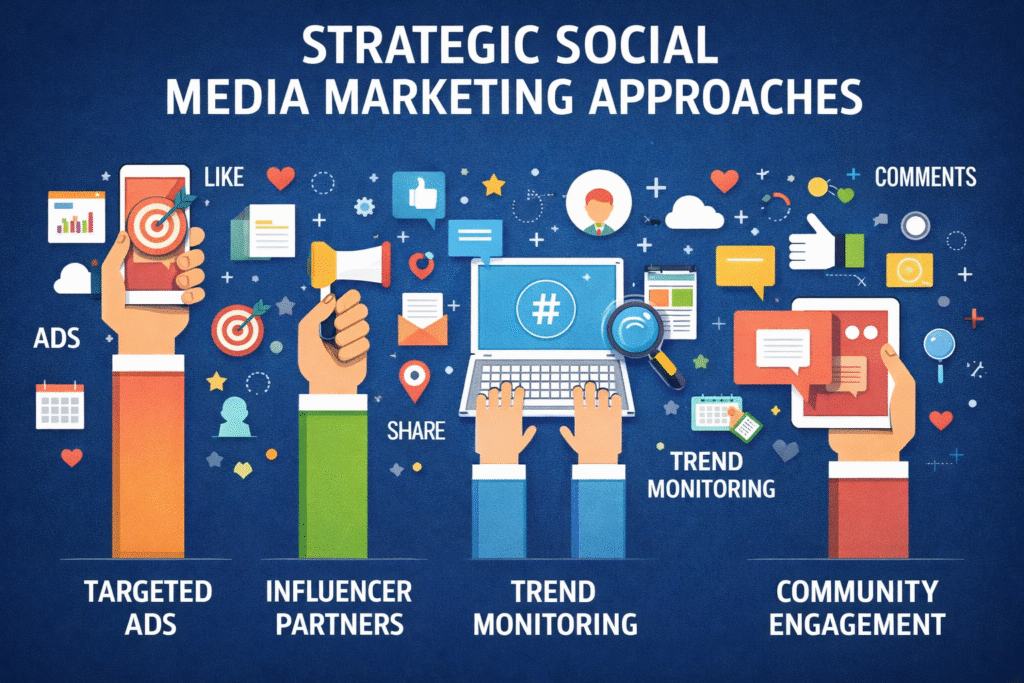
Strategic Social Media Marketing Approaches
Successful social media marketing requires strategic thinking, not just tactical posting. These approaches create comprehensive programs that deliver sustained results.
Define Clear Goals and Objectives
Every effective social media strategy begins with clear goals aligned with business objectives. Are you focused on increasing brand awareness to reach new audiences? Driving website traffic to content or products? Generating leads through gated content or inquiries? Boosting sales directly through social commerce? Improving customer service through responsive engagement? Building community around your brand?
Different goals require different strategies, content, and metrics. Clarity about objectives focuses efforts and enables measuring success meaningfully.
Know Your Target Audience Intimately
Deep understanding of your target audience is fundamental. Who are they demographically—age, gender, location, income, education? What are their interests, hobbies, and passions? What problems do they face that your business solves? What questions do they ask? Which social media platforms do they use and when?
Create detailed audience personas representing your ideal customers. Use platform analytics, customer surveys, social listening, and market research to build accurate pictures. The better you understand your audience, the more relevant and engaging your content becomes.
Choose the Right Platforms Strategically
You don’t need a presence on every platform. Focus on platforms where your audience is active and that align with your content strengths and business objectives. B2B companies might prioritize LinkedIn while visually-oriented consumer brands focus on Instagram and Pinterest.
Platform selection also depends on your resources. Managing multiple platforms well requires significant time and effort. Starting with one or two platforms and executing excellently is better than spreading thin across many platforms with mediocre results.
Develop a Comprehensive Content Strategy
Your content strategy guides what you create and share. It should include content pillars—core themes that support your brand and resonate with your audience. A fitness brand might have pillars around workouts, nutrition, motivation, and success stories.
Plan content mix—educational content that helps and informs, entertaining content that delights and engages, inspirational content that motivates, promotional content that drives action, and user-generated content that builds community.
Create a content calendar planning content weeks or months ahead. This organization ensures consistency, prevents last-minute scrambling, enables strategic coordination with product launches or events, and allows thoughtful content creation rather than rushed posting.
Prioritize Visual Quality
Visual content dominates social media. Images, videos, infographics, and graphics capture attention and drive engagement far more effectively than text alone. Invest in creating high-quality visuals that reflect your brand and stop the scroll.
This doesn’t necessarily mean expensive production. Authentic, behind-the-scenes content often outperforms overly polished material. Consistency in style, colors, and aesthetic matters more than perfection. Tools like Canva make professional-looking graphics accessible without design expertise.
Video especially drives engagement. Short-form videos (Reels, TikToks, YouTube Shorts) reach massive audiences algorithmically. Live videos create urgency and authentic connection. Long-form videos on YouTube build authority through educational content.
At Classify Skill Education, we teach comprehensive social media strategy development, helping you create customized approaches aligned with your specific business goals, audience, and resources.
Social Media Marketing Best Practices for Maximum Impact
Implementing proven best practices elevates your social media marketing from mediocre to exceptional, maximizing engagement, reach, and business results.
Post Consistently but Strategically
Consistency builds audience expectations and maintains visibility in algorithms that reward active accounts. However, consistency doesn’t mean posting constantly. Quality trumps quantity. It’s better to post high-quality content 3-4 times weekly than mediocre content daily.
Find your optimal posting frequency through experimentation and analytics. Monitor engagement rates as you adjust frequency. Too much content overwhelms audiences and dilutes quality. Too little content causes your brand to fade from awareness.
Engage Authentically with Your Community
<u>Social media engagement</u> is two-way. Don’t just broadcast—participate. Respond to comments on your posts promptly and personally. Answer questions helpfully. Thank people for positive feedback. Address concerns professionally. Like and comment on your followers’ content. Join relevant conversations in your industry.
This engagement builds relationships that create loyal communities. People support brands that acknowledge and value them. Authentic interaction transforms passive followers into active advocates.
Leverage Hashtags Strategically
<u>Hashtags</u> improve <u>content discoverability</u> by categorizing content and making it searchable. Research relevant hashtags in your industry—both popular broad hashtags and niche-specific ones. Mix trending hashtags with consistent branded hashtags unique to your business.
Hashtag strategy varies by platform. Instagram allows many hashtags (though 3-5 targeted ones often perform best). Twitter typically uses 1-2 hashtags. LinkedIn uses 3-5 hashtags. TikTok thrives on trending hashtags. Study platform norms and competitor approaches.
Create branded hashtags for campaigns or ongoing use. Encourage customers to use them when sharing content about your brand, creating user-generated content streams you can leverage.
Utilize Social Media Analytics
Social media analytics reveal what works and what doesn’t. Monitor metrics including reach (how many people see your content), engagement rate (percentage who interact), click-through rate (percentage who click links), follower growth rate, and conversions (desired actions taken).
Platform native analytics provide valuable data. Third-party tools like Hootsuite, Sprout Social, or Buffer aggregate metrics across platforms for comprehensive analysis. Review analytics regularly—weekly or monthly—to identify trends, successful content patterns, and optimization opportunities.
Focus on metrics aligned with your goals. If building awareness, emphasize reach and impressions. If driving engagement, focus on likes, comments, shares, and saves. If generating leads, track click-throughs and conversions.
Invest in Social Media Advertising
While organic reach is valuable, <u>social media advertising</u> dramatically extends your reach and enables precise targeting. Social ads reach specific audiences based on demographics, interests, behaviors, location, and even lookalike modeling that finds people similar to your best customers.
Start with modest budgets to test ads and learn what resonates. Social advertising platforms provide detailed performance data enabling rapid optimization. Test different ad formats, audiences, creative, and messages to find winning combinations, then scale successful campaigns.
Most platforms offer various ad objectives—awareness, consideration, conversion. Choose objectives aligned with your goals. Awareness campaigns prioritize reach and impressions. Conversion campaigns optimize for specific actions like purchases or signups.
Show Your Brand Personality
Social media rewards authentic personality more than corporate polish. Show the humans behind your brand. Share behind-the-scenes content. Use humor appropriately for your brand. Take positions on relevant issues. Share failures and lessons learned, not just successes.
This authenticity creates emotional connections that pure product promotion cannot achieve. People follow brands that entertain, inspire, or inform them, not brands that constantly sell. Lead with value and personality; sales follow naturally.
Collaborate with Influencers
<u>Influencer marketing</u> leverages creators with established audiences to promote your brand. Influencers have built trust with their followers; their recommendations carry weight. Choose influencers whose audience aligns with yours and whose values match your brand.
Micro-influencers (10k-100k followers) often deliver better engagement rates and ROI than mega-influencers despite smaller reach. Their audiences are highly engaged and trust their recommendations. Nano-influencers (1k-10k followers) offer even more targeted reach and authentic endorsements.
Provide influencers creative freedom rather than overly scripted content. Their audience follows them for their authentic voice; obviously branded content loses effectiveness.
Stay Current with Trends
Social media evolves constantly. Platforms introduce new features, algorithms change, trends emerge and fade. Staying current ensures your strategies remain effective. Follow industry blogs and podcasts. Participate in professional communities. Test new features and formats.
However, don’t chase every trend indiscriminately. Evaluate whether trends align with your brand and resonate with your audience. Authentic participation in relevant trends works; forced trend-jumping appears desperate and inauthentic.
Essential Social Media Marketing Tools
Effective social media management requires tools that streamline workflows, improve efficiency, and provide insights.
<u>Scheduling tools</u> enable planning and automating posts across multiple platforms. Hootsuite offers comprehensive social media management across all major platforms. Buffer provides user-friendly scheduling and analytics. Sprout Social delivers enterprise-level features including team collaboration. Later specializes in visual content planning, particularly Instagram. These tools allow creating content batches when inspired rather than daily scrambling, maintaining consistent posting even during busy periods.
<u>Design tools</u> create professional visual content. Canva provides templates, graphics, and design tools accessible to non-designers. Adobe Creative Suite (Photoshop, Illustrator, Premiere) offers professional-grade capabilities. Mobile apps like Over and Unfold create Instagram Stories quickly on smartphones.
<u>Analytics tools</u> provide insights beyond platform native analytics. Google Analytics tracks website traffic from social media. Socialbakers offers competitive analysis and content optimization recommendations. Mention monitors brand mentions across social media and the web.
<u>Content curation tools</u> help discover relevant content to share. Feedly aggregates content from chosen sources. BuzzSumo identifies trending content in your industry. These tools supplement original content with valuable curated resources your audience appreciates.
Learn Social Media Marketing with Classify Skill Education
Ready to master social media marketing and build powerful campaigns that grow your brand and drive business results? Classify Skill Education offers comprehensive, expert-led training covering every aspect of social media strategy, content creation, community management, paid advertising, and analytics.
Our courses provide hands-on experience with all major social media platforms. You’ll create real campaigns, develop content strategies, run ads with actual budgets, and analyze performance data. Whether you’re a business owner, marketing professional, or aspiring social media manager, Classify Skill Education provides the knowledge and skills to succeed in the dynamic world of social media.
Our curriculum covers social media fundamentals and platform selection, audience research and persona development, content strategy and calendar planning, visual content creation and video production, copywriting for social media, community management and engagement techniques, social media advertising across platforms, influencer marketing strategies, analytics and performance measurement, crisis management, and emerging trends.
Taking Action: Start Your Social Media Marketing Journey
Social media marketing has evolved from experimental channels to essential business infrastructure. The brands winning today are those building authentic communities, providing consistent value, engaging genuinely with audiences, and leveraging both organic and paid strategies strategically.
Success requires commitment. Results come from consistent execution over time, not overnight viral posts. Start by auditing your current presence. Which platforms are you on? How consistent is your posting? How engaged is your audience? What’s working and what isn’t?
Define clear goals and develop strategies aligned with those objectives. Create content planning systems ensuring consistency. Engage authentically with your community. Monitor analytics and optimize continuously. Test new formats, platforms, and approaches.
If you need expert guidance and structured learning, Classify Skill Education accelerates your social media marketing journey. Our courses condense years of industry experience into practical training that transforms beginners into confident social media marketers and elevates experienced professionals to mastery.
Join the thousands who have transformed their social media presence through strategic approaches, authentic engagement, and continuous optimization. Start your journey today!
About Classify Skill Education: We are a premier digital marketing training institute offering comprehensive courses in social media marketing, email marketing, SEO, content marketing, and more. Learn from industry experts and accelerate your digital marketing career!