
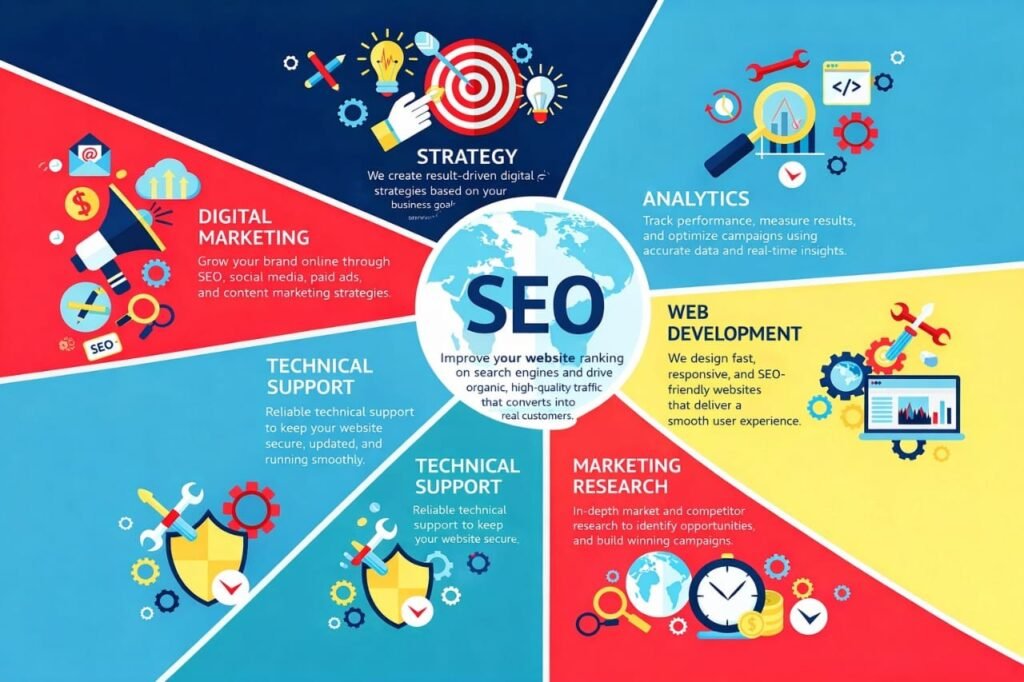
SEO marketing is a comprehensive digital marketing strategy focused on improving your website’s visibility in search engine results pages(SERPs) to drive organic traffic, increase brand awareness, and generate qualified leads. Search Engine Optimization (SEO) has evolved from simple keyword stuffing to a sophisticated discipline encompassing technical optimization, content excellence, user experience, and authority building. In today’s digital landscape where Google processes over 8.5 billion searches daily, appearing at the top of search results can transform businesses by connecting them with customers actively searching for their products or services. At Classify Skill Education, we empower businesses and marketing professionals to master SEO strategies that drive sustainable organic growth, build authority, and deliver exceptional long-term ROI in an increasingly competitive digital marketplace.
Understanding How SEO Marketing Works
SEO marketing involves optimizing your website’s content, structure, and technical elements to rank higher on search engines like Google, Bing, Yahoo, and others. When users search for specific keywords or phrases related to your business, SEO helps your website appear prominently in results, ideally on the first page where the vast majority of clicks occur. Studies show that 75% of users never scroll past the first page of search results, making top rankings crucial for visibility.
The fundamental difference between SEO and paid advertising is sustainability and cost. Paid ads deliver immediate visibility but stop working the moment you stop paying. Organic SEO generates free, long-term traffic by earning rankings through relevance, quality, and authority. While SEO requires upfront investment in time, expertise, or both, the returns compound over time as rankings strengthen and traffic increases without ongoing ad spend.
Search engines use complex algorithms with hundreds of ranking factors to determine which pages appear for specific searches. These algorithms aim to deliver the most relevant, useful, authoritative results for each query. Understanding these factors and optimizing accordingly is the essence of SEO marketing.
Google’s algorithm considers content quality and relevance, technical website performance, user experience signals, backlink quantity and quality, domain authority and trustworthiness, mobile-friendliness, page loading speed, content freshness, and numerous other factors. While the exact algorithm remains proprietary, decades of testing and Google’s own guidance provide clear direction for effective optimization.
SEO marketing works by aligning your website with what search engine reward—exceptional content that serves user intent, technically sound website infrastructure that’s easily crawlable and indexable, authoritative backlink profiles that signal trustworthiness, and positive user experience signals showing visitors find your content valuable.
Comprehensive Types of SEO Marketing
SEOencompasses three primary disciplines that work synergistically to improve rankings and traffic. Mastering all three creates comprehensive optimization programs that deliver maximum results.
On-Page SEO
On-page SEO focuses on optimizing individual web pages to rank higher and earn relevant traffic. This involves both the content users see and the HTML source code that search engines analyze.
Keyword optimization forms the foundation of on-page SEO. It begins with identifying relevant keywords your target audience searches for, then strategically incorporating them into your content naturally. This includes placing keywords in page titles, heading tags (H1, H2, H3), meta descriptions, URL slugs, image alt text, and throughout body content. However, modern SEO prioritizes natural language and semantic relevance over rigid keyword density. Google’s algorithm understands context, synonyms, and related concepts, rewarding comprehensive content that thoroughly covers topics rather than awkwardly stuffed keywords.
Content quality is paramount. Google explicitly rewards high-quality, original, useful content that demonstrates expertise, authoritativeness, and trustworthiness (E-A-T). Pages must comprehensively answer user questions, provide unique value not found elsewhere, maintain accuracy and credibility, and engage readers with well-written, properly formatted content.
Meta titles and descriptions appear in search results, influencing click-through rates. Titles should be compelling, include target keywords, and stay under 60 characters to avoid truncation. Descriptions should accurately summarize page content, incorporate keywords naturally, and entice clicks within 155-160 characters.
Header tags (H1-H6) structure content hierarchically. The H1 tag typically contains the main topic/keyword. H2s break content into major sections. H3s create subsections. Proper header structure improves readability for users and helps search engines understand content organization and emphasis.
Internal linking connects related pages on your website. Strategic internal links help search engines discover content, understand site structure, distribute page authority, and keep users engaged by guiding them to relevant additional content. Descriptive anchor text (the clickable text) tells search engines what linked pages are about.
Image optimization includes using descriptive filenames (not “IMG_1234.jpg”), adding alt text describing images for accessibility and SEO, compressing files for faster loading, and using modern formats like WebP when appropriate. Images can rank in image search, driving additional traffic.
URL structure should be clean, descriptive, and keyword-rich when natural. “example.com/seo-marketing-guide” is better than “example.com/page?id=12345”. Short, readable URLs improve user experience and may provide minor SEO benefits.
Off-Page SEO
Off-page SEO involves activities outside your website that impact rankings. The most important element is backlinks—links from other websites pointing to yours. Google interprets backlinks as votes of confidence. When reputable sites link to your content, it signals your content is valuable and trustworthy.
However, not all backlinks are equal. Quality matters more than quantity. A single link from a highly authoritative, relevant website in your industry provides more SEO value than dozens of links from low-quality, irrelevant sites. Google’s algorithm evaluates backlink quality based on the linking site’s authority and trustworthiness, relevance to your content and industry, the anchor text used in the link, the linking page’s content context, and whether links are editorial (naturally earned) versus placed (paid or exchanged).
Link building strategies for earning quality backlinks include creating exceptional content worth linking to (comprehensive guides, original research, helpful resources), guest posting on reputable industry websites, digital PR and outreach to journalists and bloggers, broken link building by finding dead links on other sites and suggesting your content as replacement, creating linkable assets like tools, calculators, or infographics, and participating meaningfully in industry communities.
Never buy links or participate in link schemes. Google penalizes these manipulative practices, potentially destroying your rankings. Focus exclusively on earning links naturally through content excellence and relationship building.
Social signals—shares, likes, and engagement on social media—aren’t direct ranking factors but correlate with higher rankings. Social distribution increases content visibility, potentially earning backlinks and traffic that do impact SEO.
Online reputation management also influences off-page SEO. Reviews on Google Business Profile, industry directories, and review sites affect local search rankings and build trust that encourages clicks from search results.
Technical SEO
Technical SEO ensures your website’s infrastructure supports optimal crawling, indexing, and ranking. Even brilliant content won’t rank if search engines can’t properly access and understand it.
Site speed significantly impacts rankings and user experience. Google explicitly uses page speed as a ranking factor, particularly for mobile search. Slow sites frustrate users, increasing bounce rates—another negative signal. Optimize speed through image compression, browser caching, minimizing CSS and JavaScript, using content delivery networks (CDNs), choosing quality hosting, and eliminating unnecessary plugins or scripts.
Mobile-friendliness is critical. Google uses mobile-first indexing, meaning it primarily uses your site’s mobile version for ranking. With over 60% of searches happening on mobile devices, responsive design that adapts seamlessly to any screen size is non-negotiable. Test mobile usability using Google’s Mobile-Friendly Test tool.
SSL certificates and HTTPS encryption are ranking factors. Secure sites display “https://” and padlock icons, building user trust and receiving ranking preference over non-secure “http://” sites. SSL certificates are inexpensive or free through services like Let’s Encrypt.
Site architecture should be logical and crawlable. Clear hierarchy with categories, subcategories, and individual pages helps search engines understand content relationships. XML sitemaps list all important pages, helping search engines discover content. Robots.txt files control what search engines can crawl.
Structured data markup (Schema.org) helps search engines understand specific content types—products, recipes, events, reviews, FAQs. This can enable rich snippets in search results, increasing visibility and click-through rates.
Canonical tags prevent duplicate content issues by indicating the preferred version when similar or identical content exists at multiple URLs. Duplicate content confuses search engines and dilutes ranking power.
404 error management ensures broken links get fixed or redirect properly. Crawl errors prevent search engines from accessing content, wasting crawl budget and creating poor user experiences.
At Classify Skill Education, we provide comprehensive training on all three SEO disciplines, ensuring you develop complete skill sets that address every aspect of optimization for maximum ranking improvement and traffic growth.
The Powerful Benefits of SEO Marketing
SEO marketing delivers substantial advantages that make it one of the most valuable long-term marketing investments businesses can make.
Sustainable Organic Traffic
Quality SEO generates sustainable organic traffic that continues flowing long after initial optimization work. Unlike paid ads that stop delivering traffic when budgets run out, earned rankings continue attracting visitors day after day, month after month. A single well-optimized page can generate thousands of visits over its lifetime, providing exponential returns on the time invested in creating and optimizing it.
This sustainability makes SEO particularly valuable for businesses with limited marketing budgets. While initial optimization requires investment, the ongoing cost is primarily maintenance and content creation rather than perpetual ad spend.
Exceptional Cost-Effectiveness and ROI
SEO marketing delivers exceptional ROI compared to most marketing channels. While exact figures vary by industry and execution quality, studies consistently show SEO outperforming paid search, display advertising, and social media advertising for cost per acquisition over time. The initial investment in optimization and content creation pays dividends for years as rankings strengthen and traffic compounds.
Additionally, organic search traffic tends to have higher conversion rates than paid traffic because users trust organic results more than ads and are further along in their research process, having actively searched for solutions.
Builds Credibility and Trust
Ranking at the top of search results builds credibility and trust. Users perceive top-ranking websites as industry leaders and authorities. This perception translates into higher click-through rates from search results and increased trust throughout the customer journey. When prospects find your helpful content through search, you’ve established expertise before the first direct interaction.
This authority compounds over time. As you rank for more keywords and appear consistently in search results, your brand becomes synonymous with industry expertise, creating competitive advantages that extend beyond just search visibility.
Targets High-Intent Traffic
SEO generates highly targeted traffic from users actively searching for information, products, or services you offer. This intent makes search traffic particularly valuable. Someone searching “best CRM software for small business” has clear purchase intent. Someone searching “how to improve email deliverability” seeks specific help you can provide. This targeting eliminates wasted reach on uninterested audiences.
Understanding user intent—whether informational, navigational, commercial, or transactional—enables creating content perfectly matched to where prospects are in their journey. This alignment improves engagement metrics and conversion rates.
Improves User Experience
Many SEO best practices directly improve user experience. Fast loading speeds, mobile-friendly design, clear site structure, quality content, and intuitive navigation all serve both search engines and human visitors. This alignment means SEO investments simultaneously improve your website’s effectiveness for actual users, creating multiple benefits from single optimizations.
Google’s algorithm increasingly prioritizes user experience signals—bounce rate, time on site, pages per session. Optimizing for these metrics improves both rankings and business outcomes since engaged visitors convert at higher rates.
Provides Competitive Advantage
In most industries, competitors invest in SEO. Not investing means ceding visibility to competitors who do. Conversely, strong SEO creates competitive advantages by capturing search visibility competitors miss, intercepting competitor brand searches through comparative content, establishing authority that makes you the obvious choice, and creating barriers to entry through entrenched rankings difficult for newcomers to displace.
Long-Term Asset Building
SEO builds long-term assets rather than renting attention through ads. Every optimized page, earned backlink, and ranking improvement adds permanent value to your digital presence. This accumulation creates compound growth where each success makes future successes easier, building momentum that accelerates results over time.
Strategic SEO Marketing Approaches for Success
Successful SEO marketing requires strategic thinking, methodical execution, and continuous optimization. These approaches create comprehensive programs that deliver sustained ranking improvements and traffic growth.
Comprehensive Keyword Research
Everything begins with thorough keyword research. Identify the search terms your target audience uses when looking for your products, services, or information. Keyword research tools like Google Keyword Planner, SEMrush, Ahrefs, Moz Keyword Explorer, and Ubersuggest provide data on search volume, competition, and related keywords.
Effective keyword research considers multiple factors. Search volume indicates how many people search for terms monthly. Competition level shows how difficult ranking will be. User intent reveals what searchers actually want—information, comparison, or to buy. Relevance ensures keywords align with your business offerings.
Target a mix of keyword types. Head terms are short, broad keywords with high volume and competition. Long-tail keywords are longer, specific phrases with lower volume but higher intent and easier ranking. For example, “shoes” is a head term while “comfortable running shoes for flat feet” is long-tail. Long-tail keywords typically drive more qualified traffic and conversions despite lower volume.
Analyze competitor keywords to identify opportunities they’re targeting and gaps you can exploit. Look for keywords they rank for that you don’t, and keywords where they rank poorly that you might capture.
Group related keywords into topic clusters. Instead of creating individual pages for similar keywords, create comprehensive pillar content covering broad topics, supported by cluster content covering specific subtopics. This structure helps search engines understand your expertise depth while avoiding keyword cannibalization where multiple pages compete for the same keywords.
Creating SEO-Optimized Content
Content marketing and SEO are inseparable. Quality content forms the foundation of successful SEO. Search engines exist to connect users with valuable information; providing exceptional content aligns perfectly with their goals.
SEO-optimized content serves dual masters—search engines and human readers. For search engines<, include target keywords naturally, use proper heading structure, incorporate related terms and synonyms, link to relevant internal and external resources, and format with optimal length (typically 1,500+ words for competitive keywords).
For human readers, provide comprehensive coverage of topics, write in clear, engaging language, break content into scannable sections with headers and bullet points, include helpful images, videos, or graphics, answer common questions thoroughly, and provide actionable takeaways.
Content types that perform well for SEO include comprehensive guides and tutorials, listicles and how-to articles, comparison and review content, original research and data-driven content, ultimate guides that exhaustively cover topics, and regularly updated resources that remain fresh and relevant.
Update existing content regularly. Google rewards fresh content, and updating top-performing pages maintains and improves rankings. Add new information, update statistics, improve formatting, expand coverage, and refresh publish dates to signal freshness.
Building Quality Backlinks Strategically
Link building remains one of the most important ranking factors and most challenging aspects of SEO. Quality backlinks require strategic effort and relationship building.
Create linkable assets—content so valuable others naturally want to link to it. Original research, comprehensive guides, useful tools, insightful analysis, and unique perspectives all attract links. Invest in creating standout content rather than mediocre posts.
Guest posting on reputable industry websites builds backlinks while establishing authority. Pitch unique, valuable content to websites your audience follows. Focus on editorial value rather than just link placement. Quality over quantity applies—one guest post on an authoritative site beats dozens on low-quality blogs.
Digital PR involves outreach to journalists, bloggers, and influencers with newsworthy stories, expert commentary, or unique data. Earning media mentions from reputable publications provides valuable backlinks and brand exposure. Tools like HARO (Help A Reporter Out) connect sources with journalists seeking expertise.
Broken link building finds dead links on other websites and suggests your content as replacement. Use tools to identify broken links on relevant sites, create content that fills the gap, and reach out offering your resource as a helpful replacement.
Create tools, calculators, templates, or resources that provide utility. These linkable assets earn natural backlinks as people discover and share them. A mortgage calculator, social media image size guide, or industry benchmark report attracts links organically.
Analyze competitor backlink profiles to find sites linking to them. Many might link to you too if approached with valuable content. Tools like Ahrefs and SEMrush reveal competitor backlinks.
Never buy links, participate in link exchanges, or use manipulative link schemes. Google penalizes these tactics, potentially causing ranking drops or manual penalties difficult to recover from. Focus exclusively on earning links through excellence.
Technical Optimization Excellence
Technical SEO creates the foundation enabling content and backlinks to drive rankings. Neglecting technical optimization undermines other efforts.
Regularly audit technical health using tools like Google Search Console, Screaming Frog, and SEMrush Site Audit. These identify issues like broken links, missing meta tags, duplicate content, slow pages, and crawl errors.
Implement structured data markup to help search engines understand specific content types. Product markup enables rich snippets showing prices and ratings. Recipe markup displays cooking times and ratings. FAQ markup creates expandable answer boxes in search results. These rich snippets increase visibility and click-through rates.
Optimize Core Web Vitals—Google’s user experience metrics including Largest Contentful Paint (loading speed), First Input Delay (interactivity), and Cumulative Layout Shift (visual stability). These metrics directly impact rankings. Use Google PageSpeed Insights to identify and fix issues.
Ensure proper indexing through XML sitemaps submitted to Google Search Console. Monitor index coverage reports to catch pages Google can’t access or chooses not to index. Fix crawl errors promptly to maintain comprehensive indexing.
Implement 301 redirects for moved or deleted pages to preserve link equity and user experience. 404 errors waste link authority and frustrate users.
At Classify Skill Education, we provide hands-on training in all these strategic approaches, teaching you to conduct professional keyword research, create SEO-optimized content, build quality backlinks ethically, and implement technical optimizations that strengthen your website’s foundation for ranking success.
SEO Marketing Best Practices for Maximum Results
Implementing proven best practices ensures your SEO efforts deliver maximum impact while avoiding common pitfalls that waste time or damage rankings.
Focus on User Intent Above All
Understanding and satisfying user intent is the most important aspect of modern SEO. Google’s algorithm has evolved to understand what users actually want when they search. Creating content perfectly matched to intent is more important than keyword density or technical tricks.
Analyze search results for your target keywords. The pages ranking at the top reveal what Google considers relevant for those queries. If top results are all comprehensive guides, users want thorough information. If they’re all product pages, users have purchase intent. Match your content to the dominant intent type.
The four main intent types are informational (seeking knowledge or answers), navigational (looking for specific websites or brands), commercial investigation (researching before purchase), and transactional (ready to buy or take action). Each requires different content approaches.
Create Comprehensive Topic Coverage
Modern SEO rewards comprehensive topic coverage over thin content targeting individual keywords. Create pillar pages thoroughly covering broad topics, supported by cluster content diving deep into specific subtopics. Interlink these strategically to demonstrate expertise breadth and depth.
This topic cluster approach helps search engines recognize you as an authority, improves internal link structure, captures rankings for numerous related keywords, and provides better user experience through comprehensive resource libraries.
Prioritize E-A-T (Expertise, Authoritativeness, Trustworthiness)
Google explicitly emphasizes E-A-T in quality guidelines. Demonstrate expertise through comprehensive, accurate content created by knowledgeable authors. Establish authoritativeness through backlinks from reputable sources, expert author bios, and industry recognition. Build trustworthiness through transparent contact information, secure website (HTTPS), professional design, and accurate, cited information.
E-A-T matters especially for YMYL (Your Money or Your Life) topics—health, finance, legal, safety—where poor information could harm users. These topics face stricter evaluation and require particular attention to credibility signals.
Monitor Performance and Optimize Continuously
SEO requires ongoing monitoring and optimization. Track keyword rankings for target terms to measure progress. Monitor organic traffic volume and trends in Google Analytics. Analyze which pages drive most traffic and conversions. Review bounce rate and time on page to gauge content quality. Track backlink growth and quality. Monitor Core Web Vitals and technical health.
Use these insights to identify opportunities. Which pages almost rank on page one and could use improvement? Which topics drive traffic and warrant expanding? Which pages underperform and need optimization or rewriting? Where are competitors outranking you and what can you learn?
SEO is never “done.” Algorithm updates, competitor actions, and market changes require continuous adaptation. Regular monitoring enables proactive optimization rather than reactive crisis management.
Stay Updated with Algorithm Changes
Google releases thousands of algorithm updates annually. While most are minor, major updates can significantly impact rankings. Follow Google algorithm updates through industry blogs, Google’s official announcements, and SEO news sources.
When updates occur, analyze their impact on your rankings and traffic. If significant drops occur, investigate what might have triggered them—content quality issues, technical problems, or link penalties. Recovery requires understanding update targets and making appropriate adjustments.
However, don’t obsess over every minor fluctuation. Focus on fundamentals—quality content, technical excellence, natural backlinks, and great user experience. Websites built on these foundations weather algorithm updates well because they align with Google’s core goals.
Avoid Black Hat SEO Tactics
Black hat SEO techniques attempt to manipulate rankings through methods violating search engine guidelines. These include keyword stuffing, hidden text or links, cloaking (showing different content to search engines versus users), link schemes, thin affiliate content, automated content generation, and scraped content.
These tactics might produce short-term gains but inevitably result in penalties ranging from ranking drops to complete deindexing. Recovery is difficult and time-consuming. Never risk your website’s long-term health for temporary shortcuts. Stick to white hat, ethical SEO that builds sustainable success.
Essential SEO Marketing Tools
Effective SEO marketing requires tools that provide data, streamline workflows, and uncover opportunities.
Keyword research tools identify opportunities and analyze competition. Google Keyword Planner provides search volume and competition data directly from Google. SEMrush offers comprehensive keyword research plus competitor analysis. Ahrefs delivers extensive keyword data plus powerful backlink analysis. Moz Keyword Explorer provides keyword suggestions and difficulty scores.
SEO audit tools identify technical issues and optimization opportunities. Screaming Frog crawls websites like search engines, revealing technical problems. SEMrush Site Audit automatically identifies issues and prioritizes fixes. Google Search Console provides direct insights from Google about indexing, performance, and issues.
Backlink analysis tools monitor your link profile and analyze competitors. Ahrefs offers the most comprehensive backlink database. Majestic provides link intelligence metrics. SEMrush includes backlink tracking alongside other features.
Rank tracking tools monitor keyword positions over time. SEMrush, Ahrefs, and Moz all include rank tracking. SE Ranking specializes in affordable rank tracking. These tools reveal ranking progress and identify opportunities.
Analytics platforms measure traffic and conversions. Google Analytics tracks website traffic, user behavior, and conversions. Google Search Console shows search performance specifically. Both are free and essential for any SEO program.
Master SEO Marketing with Classify Skill Education
Ready to master SEO marketing and drive sustainable organic growth to your website? Classify Skill Education offers comprehensive, expert-led training covering every aspect of search engine optimization, from foundational concepts through advanced strategies used by leading SEO professionals.
Our courses provide hands-on experience with industry-standard tools and real-world optimization projects. You’ll conduct professional keyword research, optimize actual websites, build backlinks ethically, implement technical optimizations, and analyze performance using professional analytics. Whether you’re a business owner wanting to improve your website’s visibility, a marketer expanding your skill set, or someone starting an SEO career, Classify Skill Education provides the knowledge and practical experience to succeed.
Our curriculum covers SEO fundamentals and search engine basics, comprehensive keyword research methodologies, on-page optimization techniques, technical SEO and website performance, content strategy for SEO, link building strategies and outreach, local SEO for businesses, SEO analytics and reporting, algorithm updates and adaptation strategies, and emerging SEO trends and technologies. You’ll complete the program with a portfolio demonstrating real optimization results and strategic understanding that drives rankings.
Taking Action: Start Your SEO Marketing Journey
SEO marketing is one of the most valuable long-term investments businesses can make in their digital presence. The sustainable traffic, exceptional ROI, credibility building, and competitive advantages make SEO essential for online success.
Start by auditing your current website. How does it perform technically? What content exists? What keywords do you rank for? Where are opportunities for improvement? Tools like Google Search Console and free versions of SEO platforms provide starting insights.
Conduct keyword research to understand what your audience searches for. Create an optimization roadmap prioritizing quick wins and important long-term targets. Begin improving technical foundations, creating quality content, and building relationships that earn backlinks.
Remember that SEO is a marathon, not a sprint. Results compound over time. Consistency and quality beat sporadic bursts of activity. The businesses dominating search results today started years ago and maintained consistent effort. Start your journey today, stay committed, and watch your visibility and traffic grow steadily.
If you need expert guidance, structured learning, and proven frameworks, Classify Skill Education accelerates your SEO journey. Our courses condense years of industry experience into practical training that transforms beginners into confident SEO practitioners and elevates experienced marketers to advanced mastery.
Join thousands who have transformed their organic visibility through strategic SEO quality content, technical excellence, and ethical link building. The digital landscape rewards those who invest in sustainable optimization. Start your SEO transformation today!
About Classify Skill Education: We are a premier digital marketing training institute offering comprehensive courses in SEO, content marketing, social media marketing, email marketing, paid advertising, and analytics. Our expert instructors bring real-world experience from top agencies and brands. Learn practical skills, build professional portfolios, and accelerate your digital marketing career with industry-recognized training. Visit us today to explore our programs and start your journey toward digital marketing excellence!