
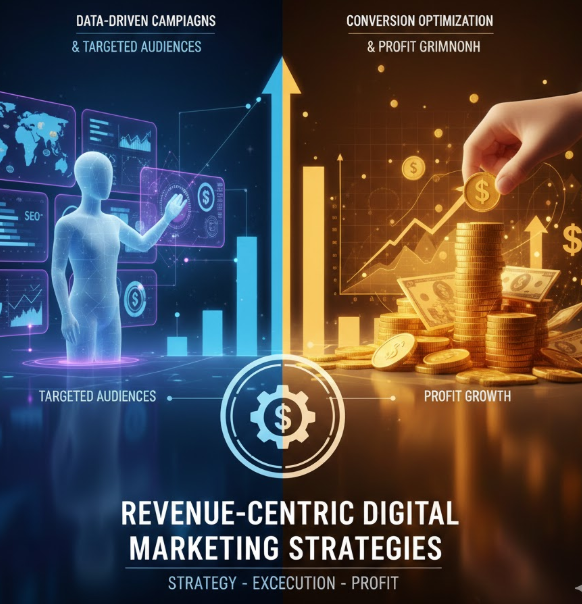
In today’s hyper-competitive digital landscape, businesses can no longer afford to invest in marketing strategies that look impressive on paper but fail to deliver actual revenue. The shift from vanity metrics — likes, impressions, and follower counts — to revenue-centric digital marketing strategies has become the defining difference between brands that thrive and those that simply survive. Whether you are a startup founder, a marketing professional, or someone who has recently completed a digital marketing course near me with placement, understanding how to align every digital touchpoint with revenue generation is the most critical skill you can develop in 2024 and beyond.
What Does “Revenue-Centric” Really Mean?
Revenue-centric digital marketing is an approach that places business outcomes — specifically sales, conversions, and measurable return on investment — at the very core of every marketing decision. It means that every piece of content created, every ad campaign launched, every email sequence written, and every social media post scheduled is tied back to a clear commercial objective. This is not about ignoring brand awareness entirely, but rather about ensuring that brand-building efforts are structured in a way that eventually feeds the revenue engine of the business.
Traditional digital marketing often focused heavily on traffic and engagement. Revenue-centric marketing asks a different set of questions: How many of those visitors actually converted? What was the cost of acquiring each paying customer? Which channel delivered the highest return on ad spend? These are the questions that business owners and CFOs care about, and they are the questions that modern digital marketers must be equipped to answer. If you are currently searching for a digital marketing institute near me, it is worth prioritizing institutions that teach this results-oriented mindset alongside technical tools.
Building a Revenue-Driven Marketing Funnel
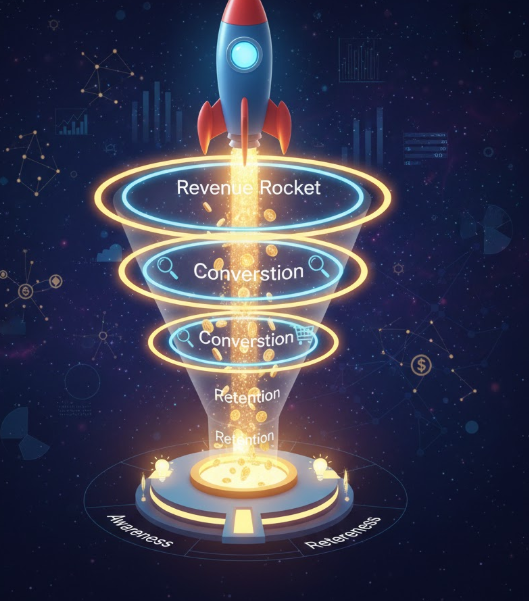
The foundation of any revenue-centric strategy is a well-structured marketing funnel that moves prospects from awareness to purchase efficiently and at scale. The funnel begins with attracting the right audience — not just any audience. Through targeted SEO content, paid search campaigns, social media advertising, and organic social media, businesses need to reach people who have a genuine problem that their product or service can solve.
Once the right visitors land on your digital properties, conversion rate optimization (CRO) becomes the next critical discipline. This involves testing landing page layouts, headlines, calls-to-action, form structures, and pricing presentations to maximize the percentage of visitors who take a desired action. Even a modest improvement in conversion rate — say, moving from a 2% to a 3% conversion rate on a landing page — can translate into a 50% increase in revenue without spending an additional rupee on advertising. Students who pursue a digital marketing course near me with internship opportunities will often get hands-on experience with A/B testing tools like Google Optimize or VWO, which are essential for mastering CRO.
Search Engine Optimization as a Revenue Channel
Search engine optimization is often misunderstood as a purely brand-building or traffic-driving exercise. When done with a revenue-centric mindset, SEO becomes one of the most powerful and cost-efficient sales channels available. The key is to focus on high-intent keywords — search terms that indicate a user is ready to buy, compare options, or solve a specific problem. These are terms like “best digital marketing software for small businesses,” “hire a digital marketing agency in Delhi,” or “affordable CRM tool for startups.”
By creating content that directly addresses high-intent search queries, businesses can capture buyers at the exact moment they are ready to make a decision. This content should not just rank well — it should convert. That means including compelling calls-to-action, social proof in the form of testimonials and case studies, clear pricing or value propositions, and a frictionless path to purchase or inquiry. A good digital marketing institute near me will teach students to align their SEO strategy with actual business goals rather than simply chasing traffic volume.
Long-tail keyword strategies are particularly valuable here. While a keyword like “digital marketing” attracts enormous search volume, the intent is unclear. But a search for “digital marketing course near me with placement guarantee” tells you exactly what the searcher wants. Creating content around these specific, intent-driven keywords is what separates revenue-focused SEO from generic content marketing.
Paid Advertising: Precision Over Volume
Pay-per-click advertising — through platforms like Google Ads, Meta Ads, and LinkedIn Ads — is arguably the fastest way to drive revenue when managed with precision. Revenue-centric paid advertising begins with knowing your customer acquisition cost (CAC) and your customer lifetime value (LTV). These two numbers determine how much you can profitably spend to acquire a new customer, and they should guide every bidding decision, audience selection, and creative choice you make.
Smart revenue-centric advertisers invest heavily in audience segmentation. Rather than running one generic campaign to a broad audience, they create tailored ad experiences for each stage of the funnel. Retargeting campaigns, for example, are extraordinarily effective at recapturing website visitors who showed interest but did not convert the first time. Research consistently shows that retargeted visitors are far more likely to convert than cold audiences, making retargeting one of the highest-ROI tactics in any digital marketer’s toolkit.
Anyone enrolled in a digital marketing course near me with internship should insist on getting exposure to real Google Ads and Meta Ads accounts. Managing live campaigns, even with small budgets, gives you the practical understanding of campaign optimization that cannot be taught through theory alone.
Email Marketing: The Highest-ROI Digital Channel
Despite the explosion of new platforms and channels, email marketing continues to deliver the highest return on investment of any digital marketing channel — often cited at forty dollars returned for every one dollar spent. From a revenue-centric perspective, email marketing is powerful because it allows businesses to nurture prospects over time, deliver personalized offers, re-engage inactive customers, and drive repeat purchases from existing buyers.
Effective revenue-centric email marketing is built on segmentation and automation. Rather than blasting the same message to your entire list, you create sequences tailored to where each subscriber is in their buying journey. A welcome sequence might introduce your brand and build trust over five to seven emails. An abandoned cart sequence might recover potentially lost sales by reminding shoppers what they left behind and perhaps offering a limited-time incentive. A post-purchase sequence might upsell complementary products, gather reviews, and encourage referrals.
The metrics that matter in revenue-centric email marketing are not open rates in isolation — they are revenue per email sent, conversion rate from email to purchase, and total attributed revenue. Learning to track and optimize these metrics is a key competency that the best digital marketing institute near me programs will incorporate into their curriculum.
Social Media Marketing with a Revenue Lens
Social media marketing, when viewed through a revenue-centric lens, becomes a far more strategic and disciplined practice. Rather than chasing followers and engagement for their own sake, revenue-focused social media marketers think about how each platform fits into the customer acquisition journey. Instagram and Pinterest might be excellent for driving top-of-funnel awareness and desire for lifestyle or consumer product brands. LinkedIn might be the primary demand generation channel for a B2B software company. YouTube might serve as both an educational and a retargeting platform.
The key is to create content that educates, entertains, or inspires in a way that ultimately leads people toward a purchase decision. This might mean sharing detailed tutorials that demonstrate the value of your product, publishing customer success stories that build social proof, or creating behind-the-scenes content that humanizes your brand and builds emotional connection. Social commerce — the ability to sell directly through platforms like Instagram Shop or TikTok Shop — has made it easier than ever to shorten the path from social content to completed transaction.
Analytics and Data: The Backbone of Revenue-Centric Marketing
None of the strategies described above can be truly revenue-centric without a robust analytics infrastructure. At minimum, businesses need Google Analytics 4 properly configured, conversion tracking set up across all paid channels, and a CRM system that connects marketing touchpoints to actual revenue outcomes. More sophisticated organizations will layer in attribution modeling to understand which channels and touchpoints deserve credit for driving conversions across complex, multi-step customer journeys.
Marketing attribution is one of the most challenging and most important concepts for aspiring digital marketers to master. Understanding the difference between first-click attribution, last-click attribution, and data-driven attribution — and knowing when to apply each model — is what allows marketers to make smarter budget allocation decisions. If you are currently looking for a digital marketing course near me with placement that will genuinely prepare you for a professional role, check whether the curriculum covers Google Analytics 4, marketing attribution, and data-driven decision making. These are non-negotiable skills in today’s market.
The Role of Content Marketing in Revenue Generation
Content marketing is often associated with slow, long-term brand building — and while that is certainly one of its functions, content can and should play a direct role in revenue generation when executed strategically. Revenue-centric content marketing focuses on creating assets that actively move prospects through the buying journey. This includes comparison pages that help undecided buyers choose your product over competitors, detailed FAQ content that addresses and eliminates purchase objections, and case studies that demonstrate specific, quantifiable results your customers have achieved.
Pillar content and topic clusters are a powerful SEO content strategy that serves both organic search visibility and revenue generation. By creating comprehensive, authoritative content hubs around your core product or service categories, you build domain authority that lifts all your pages in search rankings while simultaneously providing potential customers with everything they need to make an informed purchase decision. Students completing a digital marketing course near me with internship experience will often work on building these kinds of content strategies for real businesses, providing invaluable practical learning.
Conversion Rate Optimization: Turning Traffic Into Revenue
Driving traffic is only half the battle — converting that traffic into paying customers is where the real revenue is won or lost. Conversion rate optimization is the systematic process of improving the percentage of website visitors who complete a desired action, whether that is making a purchase, submitting a lead form, booking a consultation, or downloading a resource. It involves user research, data analysis, hypothesis formation, and rigorous A/B testing.
Great CRO practitioners understand the psychological principles that drive purchase decisions — concepts like social proof, scarcity, authority, and reciprocity — and they know how to incorporate these principles into landing page design, copy, and user experience in ethical, authentic ways. They also understand the technical side: page load speed, mobile responsiveness, form usability, and checkout flow optimization all have measurable impacts on conversion rates.
Choosing the Right Digital Marketing Education
As you build or refine your revenue-centric digital marketing skillset, choosing the right educational foundation matters enormously. When searching for a digital marketing institute near me, look for programs that teach real-world application rather than just theory. The best programs will expose you to live campaigns, real analytics data, and actual business challenges. They will cover the full spectrum of channels — SEO, paid advertising, email marketing, social media, content marketing, and analytics — while always connecting these tactics back to business revenue goals.
If placement support is a priority for you, prioritize institutions offering a digital marketing course near me with placement programs that have strong industry connections, active hiring partnerships, and alumni networks you can tap into. Placement-focused programs typically also offer resume building, interview preparation, and portfolio development support — all of which significantly increase your chances of landing a strong first role.
For those who want to accelerate their career through hands-on experience, seeking out a digital marketing course near me with internship opportunities is a smart move. An internship during or immediately after your studies gives you real-world portfolio pieces, professional references, and practical skills that classroom learning alone cannot replicate. Many hiring managers actively prefer candidates who have internship experience because it demonstrates initiative and real-world competence.
Conclusion: Revenue Is the Ultimate Metric
The evolution of digital marketing toward revenue-centric thinking reflects a broader maturation of the industry. As competition intensifies, marketing budgets come under greater scrutiny, and business leaders demand clear ROI from every investment they make. The digital marketers who will command the best careers and deliver the most value are those who understand that impressions, likes, and traffic are not the end goal — revenue is.
By building your skills around the strategies outlined in this guide — revenue-driven funnel building, high-intent SEO, precision paid advertising, smart email marketing, social commerce, robust analytics, CRO, and strategic content marketing — you position yourself as a marketing professional who speaks the language of business. Whether you are currently a student, a career changer, or an experienced marketer looking to sharpen your approach, investing in the right education at a reputable digital marketing institute near me — ideally one offering a digital marketing course near me with placement and digital marketing course near me with internship — is one of the highest-return investments you can make in your professional future.