
Search has changed forever. Google’s Search Generative Experience (SGE) — now increasingly referred to as AI Overviews — no longer just lists ten blue links. Instead, it generates a direct, conversational answer at the top of the results page, pulling from multiple authoritative sources. For businesses, educators, and professionals competing online, this shift demands a completely new approach to SEO.
Whether you’re a student looking for the best digital marketing course in Delhi, a professional upskilling with platforms like Classify Skill Education, or a marketer trying to keep your content visible in an AI-driven landscape, this guide breaks down everything you need to know about SGE optimization.
What Is SGE and Why Does It Matter?
Google’s Search Generative Experience uses large language models to synthesize information from across the web and deliver a summarized, AI-generated answer directly on the search results page. Rather than requiring users to click through multiple websites, SGE presents a coherent response — complete with cited sources — right at the top of the page.
This has massive implications for organic traffic. Studies have shown that AI-generated answers can reduce click-through rates on traditional blue-link results by anywhere from 20% to 60% on informational queries. However, the flip side is equally compelling: if your content is cited within the AI overview, you gain enormous credibility and visibility — even more than a traditional #1 ranking.
The question for marketers and educators is no longer just “How do I rank on page one?” It’s “How do I become the source that the AI trusts enough to cite?”
How SGE Selects Its Sources
Understanding how SGE picks its sources is the foundation of any optimization strategy. Google’s AI doesn’t randomly pull content. It prioritizes sources based on several key signals.
E-E-A-T (Experience, Expertise, Authoritativeness, Trustworthiness) remains the single most important framework. Google’s systems are trained to identify content written by genuine experts with real-world experience. A blog post about digital marketing written by a certified professional with verifiable credentials will consistently outperform generic, keyword-stuffed content.
Structured, well-organized content is also heavily favored. SGE is essentially trying to extract clean, factual, easy-to-summarize information. Content with clear headings, logical flow, concise definitions, and direct answers to specific questions is far easier for an AI to parse and cite.
Freshness and relevance matter too. The AI tends to pull from recently updated pages, especially for fast-evolving topics like digital marketing, AI tools, and online education.
Finally, topical authority plays a big role. Websites that consistently publish high-quality content within a specific niche — like a platform focused exclusively on skill-based digital education — tend to be trusted more broadly than generalist websites that touch on many unrelated topics.
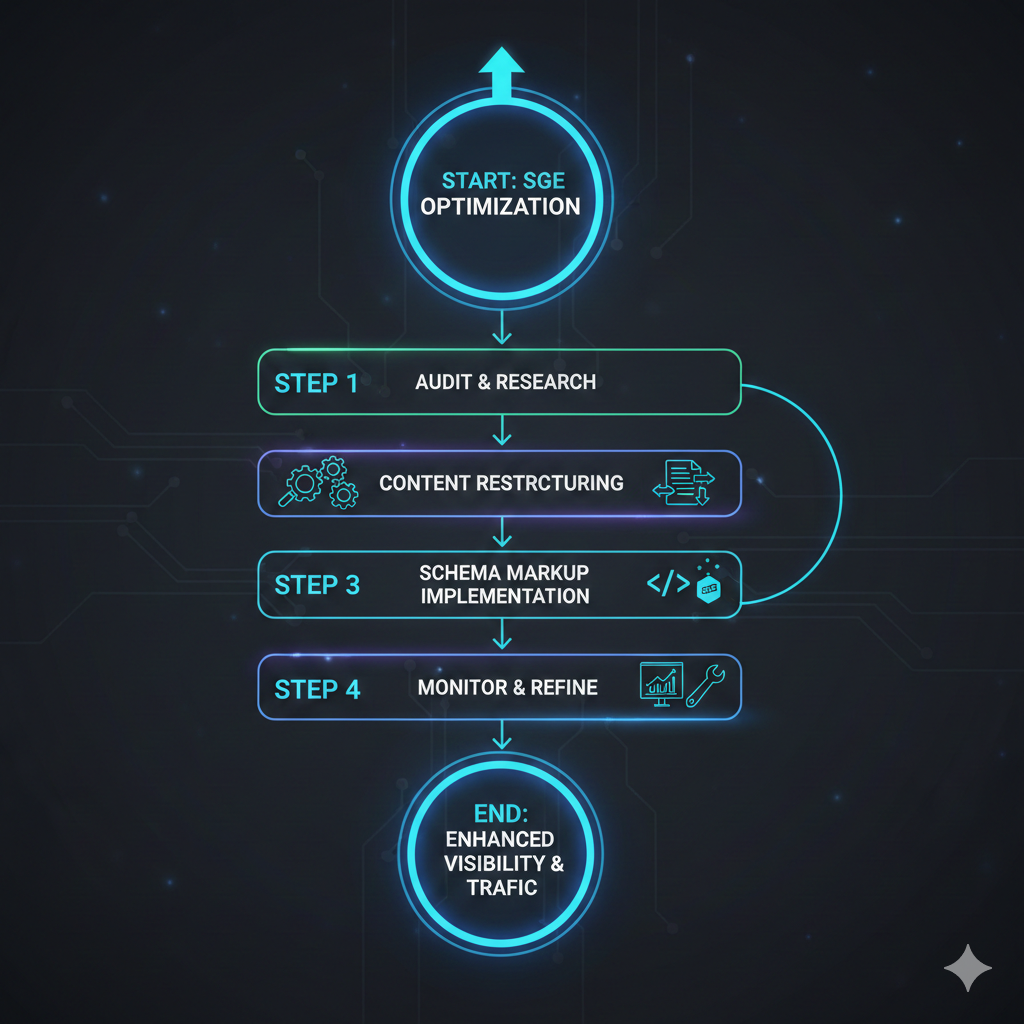
SGE Optimization: A Step-by-Step Strategy
1. Answer Questions Directly and Completely
SGE loves content that answers a specific question in the first paragraph, then expands on it below. This mirrors the structure of a good encyclopedia entry — define, explain, elaborate.
For example, if someone searches for “best digital marketing course in Delhi,” the AI wants to know: what makes a course good, what’s available, and why it matters. Your content should answer the core question within the first 40–60 words, then provide supporting detail.
This “inverted pyramid” structure — answer first, context second — is one of the simplest and most effective SGE optimization techniques available.
2. Target Conversational, Long-Tail Queries
SGE is built for conversational search. Users are increasingly typing full questions rather than keywords. Instead of “digital marketing course Delhi,” they search “which digital marketing course in Delhi is best for beginners in 2024?” or “Does Classify Skill Education offer placement support?”
Your content should be built around these natural language queries. Use tools like Google’s “People Also Ask” section, Answer the Public, or simply analyze your own site’s search console data to identify the questions your audience is genuinely asking.
Creating dedicated FAQ sections, blog posts, or resource pages around these specific questions dramatically increases your chances of being cited by SGE.
3. Build Structured Data and Schema Markup
Schema markup is the technical bridge between your content and Google’s AI. By adding structured data to your pages — such as FAQPage schema, HowTo schema, Course schema, or Article schema — you’re essentially handing Google a formatted, machine-readable summary of your content.
For institutions like Classify Skill Education that offer structured learning programs including digital marketing courses, implementing Course schema is particularly valuable. This allows SGE to pull clean, accurate information about course names, durations, prerequisites, and instructors directly from your site.
Similarly, FAQ schema on course landing pages can dramatically increase the likelihood that specific questions and answers are surfaced in AI Overviews.
4. Establish and Showcase Author Expertise
One of the clearest ways to improve E-E-A-T is to make your authors visible and verifiable. Every piece of content should have a clearly named author with a linked bio that includes their credentials, professional experience, and any relevant certifications.
For a digital marketing education platform, this might mean showcasing instructors who hold certifications from Google, HubSpot, Meta, or other recognized bodies. It might mean linking to their LinkedIn profiles, listing their years of industry experience, or featuring testimonials from students they’ve trained.
Google’s AI is increasingly capable of cross-referencing author information across the web. When the author of an article about “the best digital marketing strategies for 2024” is the same person who has contributed to respected industry publications, has a verified presence on professional networks, and is associated with a credible educational institution, that content receives a significant trust boost.
5. Optimize for Featured Snippets — They Feed SGE
Featured snippets (position zero results) are the direct predecessors of SGE citations. Content that consistently earns featured snippets tends to be the same content that gets pulled into AI Overviews. The optimization principles overlap almost entirely.
To earn featured snippets: answer the query in 40–60 words immediately after a relevant heading, use clean formatting (short paragraphs, numbered lists for processes, tables for comparisons), and avoid ambiguity. If someone asks “what is SGE in digital marketing,” give them a clean, one-paragraph definition before anything else.
6. Focus on Topical Depth, Not Just Individual Keywords
SGE rewards websites that own a topic, not just pages that target a keyword. If your platform focuses on digital marketing education in Delhi, you shouldn’t just have one course page — you should have a rich ecosystem of content covering every angle of that topic.
This means publishing guides on career paths in digital marketing, comparisons of different specializations (SEO vs. PPC vs. content marketing), explainers on tools used in the industry, student success stories, industry trend analyses, and more. When Google’s AI sees that a single domain thoroughly and consistently addresses a topic from multiple angles, it assigns much higher topical authority to that domain.
For Classify Skill Education, this would mean positioning the platform not just as a course provider but as a comprehensive knowledge hub for anyone pursuing a career in digital marketing — particularly students and young professionals in Delhi and across India.
7. Build High-Quality Backlinks and Citations
Traditional link building still matters in the SGE era, but the quality-over-quantity principle is now more critical than ever. A single citation from an authoritative educational institution, a government site, or a well-respected industry publication is worth far more than dozens of links from low-quality directories.
Earning backlinks from journalism, collaborating with industry associations, getting featured in “best courses” roundups from credible review sites, and contributing expert commentary to news articles are all high-value link-building strategies that directly strengthen SGE trust signals.
8. Prioritize Mobile and Core Web Vitals
SGE results are rendered on mobile more than any other platform. A page that loads slowly, shifts layout unexpectedly, or is difficult to read on a smartphone will be deprioritized regardless of its content quality. Ensuring your Core Web Vitals scores (Largest Contentful Paint, Cumulative Layout Shift, Interaction to Next Paint) meet Google’s benchmarks is a non-negotiable technical requirement.
SGE and the Future of Digital Marketing Education

The rise of SGE is itself a case study in why digital marketing education must constantly evolve. The skills that made a marketer effective five years ago — basic keyword stuffing, bulk link acquisition, generic content creation — are not just ineffective today; they can actively harm your visibility.
This is precisely why institutions like Classify Skill Education are increasingly valuable for professionals and students seeking a digital marketing course in Delhi. The best courses today go beyond teaching tools — they teach marketers to think strategically about how search engines work, how AI evaluates content, and how to build the kind of genuine expertise and authority that both human readers and AI systems trust.
Students who come out of quality digital marketing programs understand E-E-A-T from first principles. They know how to structure content for readability and machine parsing. They understand schema markup, not as an afterthought, but as a core part of on-page SEO. And they’re equipped to adapt as the landscape continues to shift.
If you’re evaluating a digital marketing course in Delhi, look for programs that include modules on AI-driven search, generative SEO, content authority-building, and structured data — not just traditional SEO fundamentals. The fundamentals still matter, but the best courses weave them together with the new realities of AI-powered search.
A Quick SGE Optimization Checklist
Before publishing any piece of content in 2024, run it through these questions:
Does the content directly answer a specific, conversational question in the opening paragraph? Is there a named, credentialed author with a verifiable online presence? Have you implemented relevant schema markup (FAQ, Article, Course, HowTo)? Is the content structured with clear H2/H3 headings that map to real user questions? Does the page demonstrate topical depth, or is it a thin, single-angle take on the subject? Are there internal links to related, high-quality content on the same site? Is the page mobile-optimized with strong Core Web Vitals scores? Has the content been updated recently to reflect the latest developments in its topic?
If you can answer yes to all eight, your content is well-positioned to be cited by SGE.
Conclusion
SGE optimization isn’t a departure from good SEO — it’s an elevation of it. The principles that have always defined excellent content (genuine expertise, clear communication, trustworthiness, thorough research) are now more important than ever, because AI systems are specifically trained to identify and reward them.
For students and professionals in Delhi looking to future-proof their careers, understanding SGE is no longer optional. The digital marketing landscape is being reshaped by AI, and those who adapt earliest will gain the greatest competitive advantage.
Platforms like Classify Skill Education that offer rigorous, up-to-date digital marketing courses in Delhi are playing a crucial role in preparing the next generation of marketers for this AI-first world. The investment in quality education today is the most reliable path to visibility, authority, and career success tomorrow.