
If you are learning digital marketing right now, you are entering an industry that refuses to sit still. A tool can become essential in January, get copied by three competitors by June, and feel ordinary by December. The same thing happens with platform features, ad formats, dashboards and content trends.
That creates a strange problem for students. You need current skills to get hired, but you also do not want to spend years collecting knowledge that expires every time an interface changes.
So what deserves the biggest share of your attention? Which digital marketing skill is useful even after the software, social networks and search habits around it evolve?
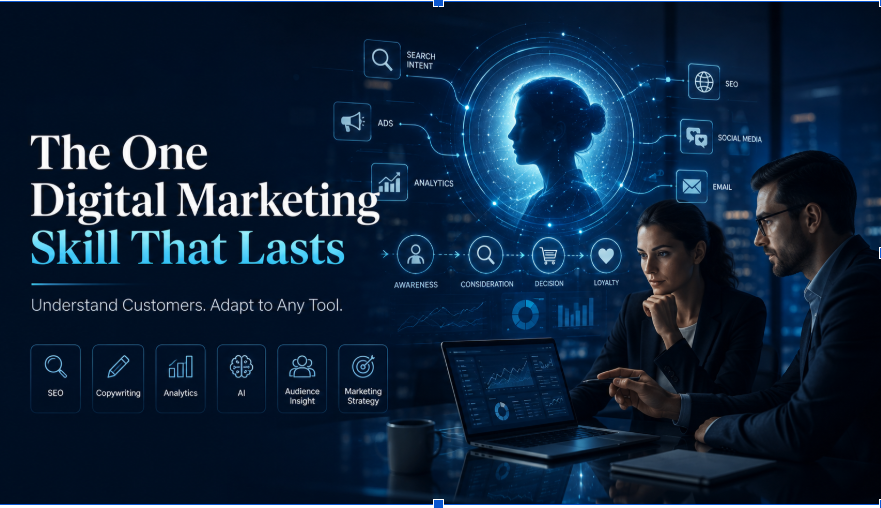
My answer is not a specific platform. It is the ability to understand people well enough to recognise what they care about, what they ignore, what they doubt and what finally moves them to act.
Call it customer understanding, buyer psychology, audience insight or marketing judgement. The label is less important than the habit. A marketer who understands people can learn new tools. A marketer who only understands tools can become stuck when the tools change.
| Platforms are rented space. Understanding people is an asset you can carry anywhere. |
Why This Skill Has a Longer Life Than Any Marketing Tool
Digital marketing will look different in the future. That is almost guaranteed. Search engines are already changing because of AI-generated answers. Ad platforms are automating more decisions. Content production is becoming faster. Analytics tools are becoming easier to use. Even the way people discover brands is shifting.
Yet the business questions underneath all that technology remain familiar. Who is the customer? What are they trying to achieve? Why would they trust this offer? Why might they hesitate? What would make the message feel relevant instead of annoying?
Those questions existed before social media. They will still exist after today’s favourite platforms stop being fashionable.
A Button Can Move. A Buying Motive Usually Does Not Move That Fast.
Imagine that you become excellent at one advertising dashboard. That knowledge can help you today, but a future update may automate half of the work you learned manually. Now imagine that you become excellent at identifying why customers compare, delay, ask for proof, seek reassurance or choose one option over another. That knowledge can be applied again and again.
This does not mean technical skills are unimportant. They are essential. The mistake is treating the tool as the foundation instead of treating it as the current method of execution.
| Learn the principle first. Learn the platform second. Update the platform skill whenever necessary. |
What “Understanding People” Means in Real Marketing Work
The phrase can sound vague until you turn it into practical questions. Good marketers keep asking questions like these before they write a headline, build a landing page or launch an ad:
- Who is this offer genuinely useful for?
- What problem is already bothering that person?
- What result are they hoping to get?
- What would make them suspicious or uncertain?
- Which details would increase confidence?
- What alternatives are they already considering?
- What language do they naturally use when describing the problem?
- What would make them take action now instead of “later”?
The answers influence almost every part of digital marketing. They affect SEO pages, ad copy, videos, emails, product pages, sales funnels and even the layout of a website.
The Same Customer Sits Behind Different Channels
A student may study SEO and Meta Ads as separate subjects, but the customer does not experience your marketing as a syllabus. The same person may discover a brand in Google, watch its Instagram video, read reviews, visit the website and then send a WhatsApp message.
The channel changes during that journey. The person’s doubts and goals travel with them.
SEO
A search query is not merely a phrase to place inside a page. It is evidence that somebody wants an answer. If a person searches for a digital marketing course in Delhi, they may be comparing fees, travel distance, course quality, practical training or job support. A useful page should understand the decision, not just repeat the keyword.
Paid Advertising
Advertising gives you only a small window to earn attention. A marketer who understands the audience can choose the right promise, example or problem to put in that window. A marketer who does not understand the audience often tries to fix weak messaging by changing targeting settings all day.
Email and Content
An email gets opened because the subject feels relevant. An article gets read because it answers a real question. A video gets watched because it creates curiosity or solves a problem. The format changes, but relevance keeps doing the heavy lifting.
Copywriting: Where Customer Understanding Becomes Visible
Copywriting is often described as persuasive writing. That is true, but there is a more useful way to think about it: copywriting is the art of translating customer understanding into clear words.
Consider a training institute promoting a course. A weak line might say, ‘We provide professional digital marketing training with expert faculty.’ The sentence is safe, polished and forgettable. It does not tell the student why the course deserves attention.
Now compare it with: ‘Build campaign skills by working on real marketing tasks instead of only collecting notes.’ The second line speaks to a student’s concern about practical learning.
The difference is not fancy vocabulary. The difference is that the second line begins with a clearer picture of what the student wants.
| If your copy sounds impressive but the customer cannot see themselves in it, the copy is decorating the wall. |
Research Before Writing: A Habit Students Should Learn Early
Many beginners start with the keyboard. Experienced marketers often start somewhere else: reviews, conversations, search results, comments, support questions and competitor pages.
Research helps you discover how customers actually speak. Businesses may say ‘integrated growth solutions.’ Customers are more likely to say ‘I need more enquiries’ or ‘I am spending on ads but not getting leads.’ The customer’s sentence is usually closer to the real problem.
Useful places to study language include:
- Google reviews of businesses in the same category
- Reddit discussions where people explain frustrations in detail
- Quora questions that reveal common confusion
- YouTube comments under tutorials and reviews
- Sales calls, enquiry messages and FAQs
- Negative reviews, because complaints expose expectations very quickly
Why AI Makes This Skill More Important, Not Less
AI is already good at producing drafts, lists, headlines, summaries and variations. It can help a marketer move faster. In the coming years, it will probably handle even more execution work.
That shifts the value of a marketer. The important question becomes less ‘Can you make something?’ and more ‘Can you decide what should be made, for whom, and why?’
Suppose an AI tool gives you twenty ad headlines. Producing twenty lines is no longer difficult. Choosing the three that fit the customer’s situation is the real work. The same is true for landing pages, email sequences and content ideas.
AI can make options cheap. Judgement becomes expensive.
| When everyone can generate, the advantage moves toward people who can evaluate. |
Do Not Build Your Career Around One Dashboard
There is nothing wrong with becoming skilled at Google Ads, SEO, analytics, social media or email marketing. In fact, students should build strong technical ability. The problem starts when your confidence depends on one platform staying exactly the same.
A safer career strategy is to build two layers:
- Layer one: durable marketing fundamentals—customer research, positioning, offers, copywriting, decision-making and measurement.
- Layer two: current execution skills—the tools and platforms employers and clients use today.
The second layer will need regular updates. The first layer becomes the reason you can adapt when those updates arrive.
A Simple Example: One Course, Three Very Different Messages
Suppose the product is a digital marketing course. Nothing about the course changes in the following examples. Only the angle changes.
Message A: “Digital Marketing Course with Multiple Modules and Certification.”
This tells us what the course contains, but it gives the student little emotional or practical reason to care.
Message B: “Learn the digital marketing skills employers expect you to use from day one.”
Now the message connects the training to employability.
Message C: “Not sure what job-ready skill to learn after college? Start by building real digital campaigns.”
This version speaks to a specific moment in a student’s life. It is more targeted because the marketer has imagined the situation behind the search.
Good marketing often improves when the audience becomes less abstract.
Five Long-Term Skills Hidden Inside Audience Understanding
1. Customer Research
Learn how to collect evidence before forming opinions. Read what customers say, compare patterns and look for repeated frustrations. Good research protects you from creating campaigns based only on assumptions.
2. Positioning
Positioning is the decision about what you want the audience to remember. ‘We teach digital marketing’ is a description. ‘Practical digital marketing training for students preparing for real work’ creates a clearer place in the customer’s mind.
3. Clear Communication
The internet does not reward complexity simply because it sounds professional. Strong marketers can explain a benefit, a process or a problem without making the audience work unnecessarily hard.
| Confusing people is not a premium branding strategy. |
4. Basic Sales Understanding
Sales conversations reveal objections that marketing teams sometimes miss. If prospects keep asking about fees, timelines or results, those questions belong in your marketing. A good salesperson can be one of a marketer’s best research sources.
5. Testing and Measurement
Understanding people does not mean trusting every instinct. You still need evidence. Test headlines, landing pages, calls to action and offers. Watch what people click, ignore and complete. Let behaviour correct your assumptions.
The strongest digital marketers combine empathy with numbers. They form a hypothesis, test it, learn from the result and try again.
A Practical Learning Roadmap for Students
If you are starting from zero, you do not need to learn the entire industry at once. A sensible path is easier to manage.
Stage One: Learn the Marketing Basics
- Target audience and customer segments
- Customer journey and funnels
- Value propositions and offers
- Basic branding and positioning
- Copywriting fundamentals
- Consumer behaviour and trust
- Measurement and experimentation
These topics can feel less exciting than a shiny new tool, but they make every later tool easier to understand.
Stage Two: Choose One Technical Area
Pick one field and go deeper than the average beginner. It could be SEO, Google Ads, Meta Ads, email marketing, content strategy, social media or analytics.
Trying to master everything at the same time usually produces a collection of introductions. Depth gives you something you can actually practise.
Stage Three: Build Something Real
Create a small project. Start a blog, help a local business, run a low-budget campaign, build a landing page or grow a niche social account. Real work introduces problems that tutorials conveniently skip.
| Certificates show that you finished a course. Projects show what stayed in your head afterward. |
Stage Four: Study Real Reactions
Once your work is live, watch what happens. Which posts get replies? Which pages keep attention? Which messages confuse people? Which questions appear repeatedly? This is where marketing stops being a collection of theories and becomes observation.
Stage Five: Use AI Without Handing Over Your Brain
Use AI to brainstorm, organise, compare and speed up repetitive work. But keep the final judgement. Ask whether the output fits the customer, the brand and the purpose. A fast wrong answer is still wrong.
Curiosity Is the Quiet Advantage
There is another skill underneath all of this: curiosity. Good marketers notice things other people scroll past.
- Why did this advertisement make me stop?
- Why did I ignore the next one?
- Why do customers keep mentioning the same complaint?
- Why does one competitor feel more trustworthy?
- Why did the campaign work for one audience but fail for another?
If you develop the habit of asking those questions, everyday internet use becomes a marketing lesson. A product page, a restaurant review or a badly written ad can all teach you something.
| A marketer can learn almost anywhere. The danger is becoming so busy posting that you stop noticing. |
Will “Digital Marketing” Even Be Called Digital Marketing in the Future?
Possibly not. As digital channels become inseparable from everyday life, the word ‘digital’ may become less useful as a separate label. Marketing may simply mean reaching and serving customers across whatever channels exist at the time.
The job will still involve familiar goals: earning attention, explaining value, creating trust, generating demand and maintaining customer relationships. The technologies around those goals will change more quickly than the goals themselves.
That is why students should avoid building an identity around one piece of software. Build your identity around a business problem you can help solve.
So, What Is the One Skill?
If I had to choose a single digital marketing skill with the best chance of remaining useful for decades, I would choose the ability to understand customers and turn that understanding into better decisions.
That skill improves your copywriting. It improves your advertising. It improves SEO because you think about search intent instead of keyword stuffing. It improves content because you choose topics people care about. It improves websites because you recognise what visitors need before they take action.
And, importantly, it makes it easier to adapt to whatever comes next.
Conclusion
Students often ask which digital marketing skill will be safest for the future. There is no platform with that guarantee. Platforms can be replaced. Features can be automated. Interfaces can be redesigned overnight.
A better long-term bet is learning how customers think and decide.
Study people. Learn their language. Understand their goals and objections. Practise writing clearly. Learn how offers and positioning work. Then use SEO, advertising, analytics, social media and AI as tools for applying those principles.
Years from now, your screen may look completely different. The customer on the other side will still be asking some version of the same question: ‘Is this right for me?’
A marketer who can answer that question clearly will continue to be useful.