
Open Instagram right now. Count how many ads you see for a “digital marketing course” in the next two minutes. Chances are, you’ll lose count.
Digital marketing courses have become one of the most heavily advertised education categories in India today. Every scroll brings a new promise — “get placed in 45 days,” “learn AI-powered marketing,” “earn ₹50,000 a month working from home.”
That naturally raises a fair question. Is this whole industry overhyped? Or is there a real, lucrative career hiding underneath all the marketing noise?
We looked into this honestly, without the sales pitch. Here’s what we found.
Why Digital Marketing Courses Are Booming (The Hype Side)
Let’s start with why you’re seeing so many ads for these courses in the first place.
- Every business, from a local bakery to a multinational bank, now needs an online presence. That single shift created a hiring wave.
- The entry barrier is low. You don’t need an engineering degree or an MBA to get started.
- Training institutes have noticed this demand and are marketing aggressively — sometimes more aggressively than actual industry demand justifies.
- Courses can be finished in months, not years, which makes them attractive to fresh graduates and career switchers alike.
Real demand, a low entry barrier, and aggressive marketing together are exactly what creates hype. And hype isn’t always a bad sign — sometimes it just means an industry is growing fast enough that everyone wants a piece of it.
If everyone’s shouting about a career option, it usually means one of two things: it’s a bubble, or it’s genuinely blowing up. With digital marketing, the data says it’s the second one.
Is It Really Overhyped? Breaking Down the Skepticism
Here’s the part most course advertisements won’t tell you.
- Certificates don’t guarantee jobs. No course, however expensive, can promise you a placement. What actually gets you hired is a portfolio of real work.
- The entry-level market is crowded. Thousands of people finish similar courses every month, so a certificate alone no longer makes you stand out.
- Free content exists everywhere. Google’s own certifications, YouTube tutorials, and other free academies teach the same fundamentals. Some paid courses are essentially a guided tour through material you could find without spending a rupee.
- Quality varies wildly between institutes. Some still teach tactics that stopped working years ago.
A digital marketer with over a decade of hands-on experience made an important point in a recent online discussion: AI hasn’t eliminated the need for skilled people on their team — not for content, not for advertising, and not for SEO. What has changed is that professionals now need to understand more than one discipline and back it up with real platform experience, not just theory. That’s a far more useful way to think about “hype” than any course advertisement.
So yes, some of the hype is real hype. If your only plan is “finish a course, get rich,” you’re setting yourself up to be disappointed.
A certificate can get you an interview. Only skill gets you a career.
The Real Career Side: What a Digital Marketing Course Actually Gets You
Now for the other half of the story — because the skepticism above doesn’t mean the career itself is fake.
Here’s what’s genuinely true about digital marketing as a career in 2026:
- It’s one of the few careers where you don’t need a specific degree to get in the door.
- Course-goers pick up real, transferable skills: SEO, running paid ad campaigns, writing content that converts, reading analytics dashboards, and managing social media.
- Industries across the board — healthcare, education, e-commerce, finance, real estate — all need this skillset, so you’re never boxed into one sector.
- Remote and freelance work are far more common here than in most other careers.
- Income isn’t capped by a fixed pay scale. Freelancers and specialists routinely out-earn generalists who’ve been in the industry twice as long.
The people who benefit most from a course are:
- Fresh graduates who don’t yet have a clear career direction
- Career switchers coming from unrelated fields
- Small business owners who want to market their own products
- Content creators looking to monetize their skills more strategically
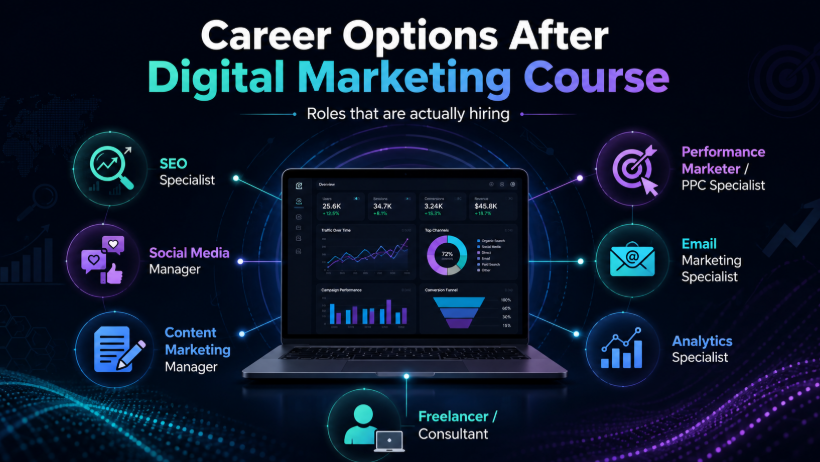
Career Options After Digital Marketing Course
This is usually where people get stuck — “I finished the course, now what?” Here are the paths that are actually hiring.
SEO Specialist
You help websites rank higher on Google without paid ads. The role blends research, writing, and some technical thinking about how websites work. It stays one of the more stable specialisations because organic search still drives most of the traffic for most businesses.
Social Media Manager
You build and manage a brand’s voice across platforms like Instagram, LinkedIn, and YouTube. This role suits people who enjoy creativity, storytelling, and keeping up with trends.
Content Marketing Manager
You plan and oversee the blogs, videos, and other content that attract an audience and build trust before a sale happens. Strong writing and strategic thinking matter here more than raw creativity alone.
Performance Marketing / PPC Executive
You manage paid campaigns on Google Ads and Meta Ads, where your work is measured directly in numbers — clicks, conversions, and return on ad spend. This tends to be one of the higher-paying specialisations because the impact on revenue is easy to prove.
Email Marketing Specialist
You build campaigns that keep existing customers engaged and coming back. It’s a quieter role than social media, but retention marketing like this is often cheaper and more profitable than constantly chasing new customers.
Marketing Analytics Specialist
You dig into website traffic, campaign performance, and conversion data, then turn it into decisions the rest of the team can act on. If you enjoy dashboards more than design tools, this path pays well and skilled people are in short supply.
Digital Marketing Consultant or Freelancer
Once you’ve built real experience, you can work independently with multiple clients instead of one employer. This path offers the most flexibility and, for experienced professionals, often the highest earning ceiling.
Across all these roles, salaries in India typically start around ₹2.5–4 lakh a year for freshers and can climb past ₹20–25 lakh a year at senior, specialist, or leadership levels — with performance marketing and analytics roles usually commanding the biggest premiums because their impact on revenue is the easiest to measure.
Digital Presence Isn’t Going Anywhere — Here’s the Proof
If you’re still wondering whether this career has real staying power, look at where people actually are.
- More than 2 out of every 3 people on Earth now use social media every month, based on DataReportal’s most recent Digital 2026 Global Overview report.
- The average person spends well over two hours a day on social platforms, adding up to billions of hours of collective attention every single day.
- Global social media ad spending has been projected well above $270 billion, with Meta, YouTube, and TikTok alone accounting for a huge share of that.
As long as this much of the world’s attention lives online, businesses will keep paying people to reach it. That’s not hype — that’s just where the audience is.
As long as people are scrolling, someone needs to be the reason they stop scrolling. That’s the job of a digital marketer.
AI too is not going to kill digital marketing career options. In the future someone who can use AI better than you will be earning more than you.
So, Overhyped or Career Booster? Our Verdict
Here’s the honest answer: digital marketing courses are overhyped in their marketing, but not overhyped as a career.
The industry has genuine, growing demand for skilled professionals. But too many advertisements sell the certificate as the destination, when it’s really just the starting line. The gap between “finished a course” and “built a career” gets filled with practice, portfolio-building, and picking up more than one discipline.
If you go in expecting a course to hand you a job, you’ll likely feel let down. If you go in expecting a course to teach you the fundamentals — and you’re willing to practice, specialise, and keep learning as tools change — the career on the other side is very real, and for many people, genuinely lucrative.
The course gets you in the room. What you do after is what gets you paid.
Frequently Asked Questions
Is digital marketing a good career for freshers?
Yes. Most entry-level roles like SEO executive, social media executive, or content writer don’t require prior experience — just a working portfolio, even a personal one, built during or after your course.
Is digital marketing a good career for the future?
Yes. As long as businesses need to be found online, this skillset stays relevant. What will keep changing is which specific tools and platforms matter — which is exactly why continuous learning is part of the job, not an optional extra.
What is the salary scope in digital marketing?
It ranges widely — from around ₹2.5–4 lakh a year for freshers to ₹20 lakh and above for senior specialists and managers, with freelancers able to earn well beyond that depending on their client base.
Is digital marketing a good career for introverts?
Yes, more than people expect. Roles like SEO, analytics, and email marketing rely far more on research and writing than on constant client-facing interaction, which makes them a good fit for people who prefer quieter, focused work.
Conclusion
Whether digital marketing is “overhyped” really depends on what you’re comparing it to. As a marketing message, plenty of courses oversell what a certificate alone can do. As an actual career, the demand, the salary range, and the variety of roles are backed by real numbers, not just Instagram ads.
The smartest move isn’t to blindly trust the hype or dismiss it outright. It’s to treat a course as step one — and treat everything that comes after it as the part that actually builds your career.