
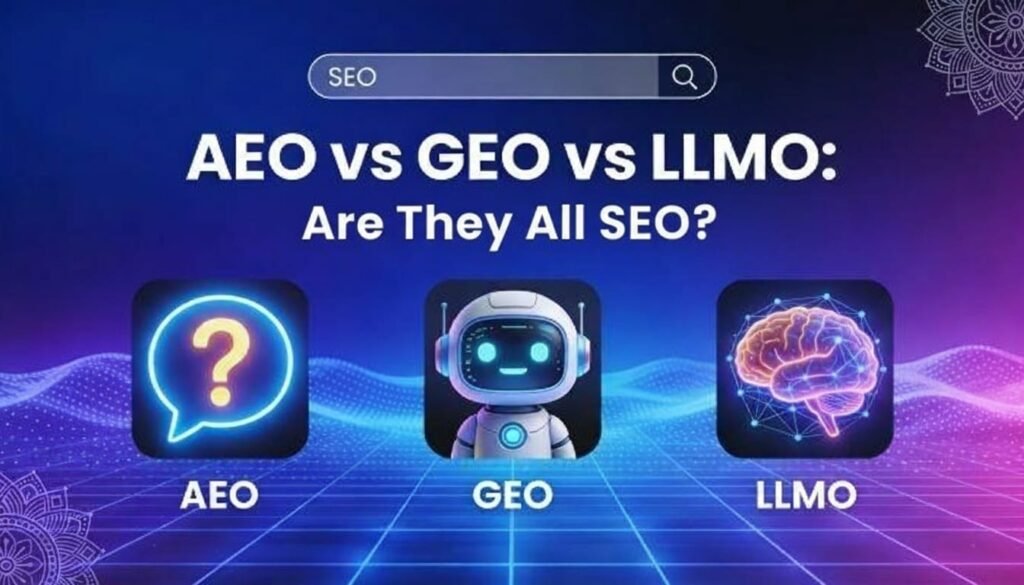
The digital marketing landscape is evolving rapidly, and with it comes a new alphabet soup of optimization strategies. You’ve likely heard of SEO (Search Engine Optimization), but what about AEO, GEO, and LLMO? Are these just fancy new terms for the same old SEO tactics, or are they fundamentally different approaches? Let’s break down each one and understand how they fit into the modern search ecosystem.
At Classify Skill Education, we believe in staying ahead of digital marketing trends and equipping professionals with future-ready skills that will keep them relevant in an ever-changing landscape. Understanding these emerging optimization strategies is not just beneficial – it’s crucial for anyone looking to excel in the evolving world of digital marketing and search optimization.
Understanding the Evolution
To truly appreciate where we are today, we need to understand where we’ve been. Traditional SEO focused primarily on ranking websites in search engine results pages (SERPs). The game was straightforward: optimize your website with the right keywords, build quality backlinks, ensure technical excellence, and watch your rankings climb.
However, the way people search for and consume information has dramatically changed over the past decade. Voice assistants like Siri, Alexa, and Google Assistant have made verbal queries commonplace. AI chatbots have emerged as powerful information sources. Featured snippets now answer questions directly on the search results page. These technological advances have transformed the search landscape entirely, giving rise to these new optimization strategies.
The shift isn’t just technological – it’s behavioral. Users today expect instant answers, conversational interactions, and personalized results. They’re asking complex questions in natural language, expecting comprehensive answers synthesized from multiple sources, and increasingly relying on AI to filter and present information.
What is AEO (Answer Engine Optimization)?
<u>Answer Engine Optimization</u> represents a fundamental shift in how we think about search optimization. Rather than simply aiming to rank well in a list of search results, AEO is all about optimizing your content to be the direct, immediate answer to user queries.
Instead of just ranking high in search results, AEO aims to have your content featured in position zero – that coveted spot above all other organic results. This includes featured snippets, knowledge panels, direct answer boxes, and various other formats that search engines use to provide immediate answers.
Key characteristics of AEO:
- Direct Answer Focus: The primary focus is on providing concise, direct answers to specific questions. Your content needs to anticipate what users are asking and provide clear, unambiguous answers that search engines can easily extract and display.
- Structured Content: AEO heavily emphasizes structured data and schema markup. These technical implementations help search engines understand the context and meaning of your content, making it easier for them to feature your information in rich results.
- Question-Based Formats: Content optimized for AEO typically follows question-based formats. FAQ pages, how-to guides, and Q&A sections are particularly effective because they naturally align with how users phrase their queries.
- Snippet-Friendly Formatting: Information needs to be formatted in ways that are easy for search engines to extract. This includes using clear headings, concise paragraphs (typically 40-60 words for featured snippets), bulleted lists, numbered steps, and tables.
Example: When someone asks “What is the boiling point of water?”, AEO-optimized content ensures your answer appears directly in the search results without requiring a click.
What is GEO (Generative Engine Optimization)?
Generative Engine Optimization is the newest kid on the block, emerging from the AI revolution.GEO focuses on optimizing content for AI-powered search experiences like Google’s Search Generative Experience (SGE) , Bing Chat, and other AI search tools that generate comprehensive answers by synthesizing information from multiple sources.
GEO addresses a fundamental shift in how search engines present information. Rather than simply ranking and displaying existing web pages, modern AI search tools like Google’s Search Generative Experience (SGE), Bing Chat, and other emerging platforms generate entirely new content by synthesizing information from multiple sources.
Key characteristics of GEO:
- AI-generated search summaries The primary focus of GEO is ensuring your content is selected and cited when AI systems generate search summaries. This requires creating content that AI can easily understand, trust, and reference.
- Source Citation Priority: Unlike traditional search where being in the top 10 results was the goal, GEO focuses on being cited and referenced by AI systems as a source. Your content needs to be authoritative enough that AI trusts it as a reliable source of information.
- Comprehensive Coverage: AI systems favor content that provides comprehensive coverage of topics. Rather than short, keyword-focused articles, GEO rewards in-depth, well-researched content that thoroughly explores subjects from multiple angles.
- E-E-A-T Excellence: E-E-A-T (Experience, Expertise, Authoritativeness, Trustworthiness) has always been important for SEO, but it’s absolutely critical for GEO. AI systems are programmed to prioritize content from sources that demonstrate clear expertise and authority.
Example: When someone searches “best practices for remote team management,” GEO-optimized content increases the likelihood of being referenced in the AI-generated overview that appears at the top of results.
What is LLMO (Large Language Model Optimization)?
Large Language Model Optimization specifically targets optimization for AI assistants and chatbots powered by large language models like ChatGPT, Claude, and Gemini. LLMO ensures your content is discoverable, understandable, and citable by these AI systems.
LLMO specifically targets optimization for AI assistants and chatbots powered by large language models like ChatGPT, Claude, Gemini, and other emerging platforms. These systems are fundamentally different from search engines because they engage in conversational interactions and maintain context across multiple exchanges.
Key characteristics of LLMO:
- Conversational Context: Unlike traditional search queries which are often fragmented keywords, conversational queries used with AI assistants are natural language questions and statements. LLMO focuses on optimizing content for these natural, conversational interactions.
- Citability and Attribution: Large language models are increasingly focused on providing accurate citations for their information. LLMO ensures your content is not only accessible to these systems but is also presented in a way that makes it easy to cite and attribute.
- Structured Information Architecture: LLMs process information differently than traditional search crawlers. LLMO emphasizes creating clear information hierarchies, using semantic markup, and structuring content in ways that AI systems can easily parse and understand.
- Authority and Reliability Signals: AI systems are trained to evaluate source reliability. LLMO requires establishing clear authority markers, including author credentials, publication dates, cited sources, and other trust signals.
Example: When someone asks an AI assistant for recommendations or explanations, LLMO-optimized content increases the chances of being referenced or recommended.
Are They All Just SEO?
Here’s the fundamental truth: AEO, GEO, and LLMO are all related to SEO, but they’re not the same thing. They represent an evolution of search optimization adapted to new technologies and user behaviors.
SEO: The Foundation
SEO is the foundation upon which all other optimization strategies are built. It’s about making your website discoverable, crawlable, and rankable in traditional search engines
Technical SEO: Ensuring your website is technically sound, with fast loading times, mobile responsiveness, proper indexing, and clean code.
On-Page SEO: Optimizing individual pages with relevant keywords, quality content, proper heading structure, and internal linking.
Off-Page SEO: Building authority through backlinks, brand mentions, social signals, and other external factors.
Content SEO: Creating valuable, relevant content that satisfies user intent and provides genuine value.
AEO: The Next Layer
AEO is the next layer that builds on SEO foundations but focuses specifically on being the featured answer, not just a ranked result. While traditional SEO aims to get you in the top 10 results, AEO aims to get you in position zero.
AEO targets the zero-click search experience – scenarios where users get their answer directly from the search results page without needing to click through to any website.
The skills required for AEO overlap significantly with SEO but require additional focus on:
- Answering specific questions concisely
- Formatting content for snippet extraction
- Using structured data more extensively
- Optimizing for voice search
- Creating FAQ and Q&A content
GEO and LLMO: The New Frontier
GEO and LLMO are the new frontier that extends optimization beyond traditional search engines into the AI-powered search and assistance ecosystem.
The distinction is crucial:
- SEO gets you ranked in search results
- AEO gets you featured as the direct answer
- GEO gets you cited in AI-generated search summaries
- LLMO gets you referenced by AI assistants
The Key Differences
| Strategy | Primary Goal | Target Platform | User Intent |
| AEO | Become the direct answer | Featured snippets, voice search | Finding quick answers |
| GEO | Be cited in AI summaries | AI-powered search (SGE, Bing Chat) | Understanding topics comprehensively |
| LLMO | Referenced by AI assistants | LLM-powered chatbots | Conversational information seeking |
Do You Need All Four?
The short answer is yes, if you want comprehensive visibility in today’s digital landscape. However, the good news is that many optimization practices overlap:
- High-quality, authoritative content benefits all four strategies
- Clear structure and formatting help both humans and AI understand your content
- Answering user questions directly serves AEO, GEO, and LLMO
- Strong technical SEO foundations support all optimization efforts
At Classify Skill Education, we teach professionals how to master all these optimization strategies through our comprehensive digital marketing courses Our curriculum covers everything from traditional SEO fundamentals to cutting-edge AI-powered search optimization ensuring you’re prepared for the future of digital marketing.
Practical Tips for Optimizing Across All Four
Create question-focused content – Structure your content around the questions your audience asks. This serves AEO, GEO, and LLMO simultaneously.
Use structured data – Implement schema markup to help search engines and AI systems understand your content context
Build topical authority – Create comprehensive content clusters around core topics to establish expertise for both traditional search and AI systems.
Optimize for natural language – Write conversationally to match how people speak to voice assistants and AI chatbots.
Prioritize clarity and accuracy – AI systems favor clear, well-organized, factual content that’s easy to parse and cite.
Why Learn These Skills with Classify Skill Education?
The digital marketing industry is rapidly evolving, and staying updated with the latest trends is no longer optional—it’s essential. At Classify Skill Education, we offer:
- Industry-relevant curriculum that covers SEO, AEO, GEO, and LLMO
- Hands-on training with real-world projects and case studies
- Expert instructors with proven track records in digital marketing
- Career support to help you land your dream job in digital marketing
- Lifetime access to course materials and updates
Whether you’re a beginner looking to start your career in digital marketing or a professional wanting to upskill, our courses are designed to give you a competitive edge in the job market.
The Bottom Line
AEO, GEO, and LLMO aren’t replacements for SEO—they’re evolutions that reflect how search and information discovery have changed. While traditional SEO helps people find your website, these newer strategies ensure your content is discovered, featured, and cited across the expanding universe of search experiences.
The smart approach is to integrate all these strategies into a cohesive <u>content optimization plan</u>. Focus on creating genuinely valuable, well-structured content that answers real user questions, and you’ll naturally optimize for traditional search engines, answer engines, and AI systems alike.
The future of search is multi-faceted, and your optimization strategy should be too. Join Classify Skill Education today and master the skills that will define the future of digital marketing. Learn from industry experts, work on real projects, and become a certified professional ready to tackle the challenges of modern search engine optimization and beyond.
Ready to master SEO, AEO, GEO, and LLMO? Enroll in Classify Skill Education’s comprehensive digital marketing program and stay ahead of the curve. Visit our website or contact us today to learn more about our courses and start your journey toward becoming a digital marketing expert!
Don’t just adapt to change – lead it. Enroll today!