
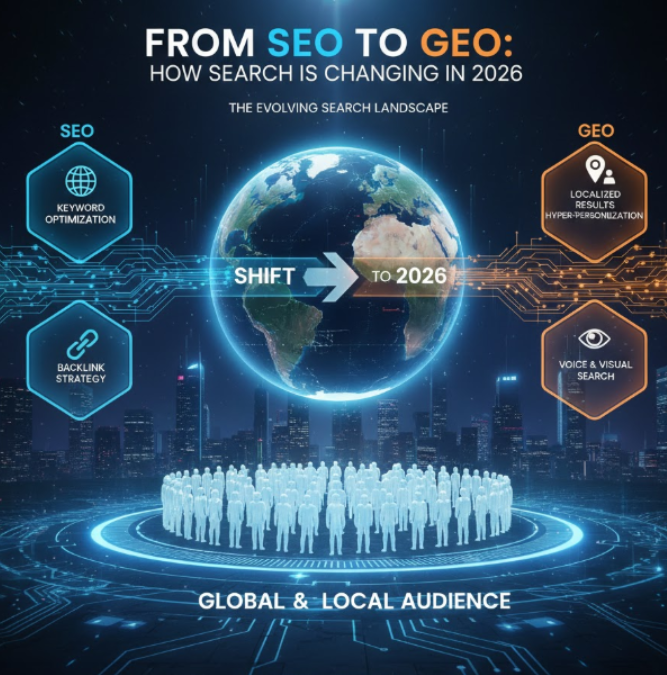
The digital world never stands still. Every few years, something comes along that rewrites the rules entirely — and right now, we’re living through one of the most profound shifts in how people search for information online. If you’ve been keeping up with the marketing world, you’ve probably started hearing a new term thrown around: GEO, or Generative Engine Optimization. And if you haven’t heard of it yet, don’t worry — by the end of this blog, you’ll not only understand what it means, but you’ll also know exactly why it matters for your career in digital marketing.
For the past two decades, SEO — Search Engine Optimization — has been the cornerstone of online visibility. Brands, bloggers, and businesses have all played the game of ranking on Google by optimizing their content with the right keywords, backlinks, and technical structures. It worked beautifully for a long time. But 2026 is telling a very different story. The rise of AI-powered search engines, generative answer models, and conversational search tools has fundamentally changed the way people find information — and marketers who don’t evolve with this change risk being left behind entirely.
What Exactly Is GEO and Why Does It Matter?
Generative Engine Optimization, or GEO, is the practice of optimizing your content not just for traditional search engines like Google, but for AI-powered generative tools like ChatGPT, Google’s AI Overviews, Perplexity, Gemini, and other large language model-based search interfaces. These tools don’t just show you a list of links — they read your content, understand it, synthesize it, and then present a direct answer to the user’s query. The user often never clicks on a website at all.
This is a seismic shift. Think about it: if someone searches “best digital marketing course in Janakpuri,” a traditional search engine would show them a list of websites, ads, and blog posts. But an AI-powered search engine will read through multiple sources, pull the most relevant information, and generate a direct, conversational answer. If your content isn’t structured in a way that AI can understand and trust, you simply won’t be featured — no matter how well you’ve optimized for traditional SEO.
This is why marketers, educators, content creators, and business owners must start understanding GEO in 2026. It’s not the future anymore — it’s happening right now, in real time.
The Key Differences Between SEO and GEO
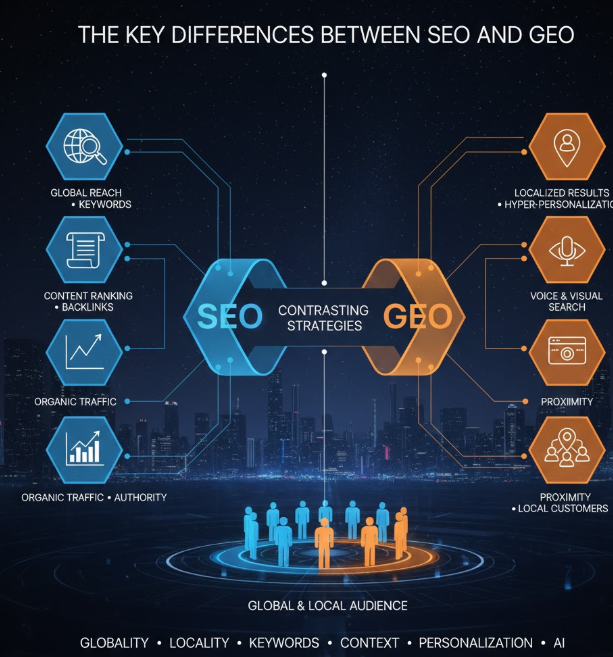
Understanding how SEO and GEO differ is critical before you can master either one. Traditional SEO focused heavily on keywords, domain authority, backlinks, metadata, and page speed. It was largely a technical game with creative elements layered on top. GEO, on the other hand, is about authority, clarity, depth, and trustworthiness of information.
In GEO, AI systems are trying to figure out whether your content is genuinely helpful and accurate. They analyze your writing style, the structure of your arguments, how well you answer specific questions, whether you cite credible sources, and how conversationally useful your content is. A piece of content that’s stuffed with keywords but lacks depth will be completely ignored by generative engines, even if it once ranked on the first page of Google.
GEO also demands a different kind of content creation. You need to write in a way that directly answers questions. You need to use natural language that mirrors how real people ask questions in 2026 — not how marketers used to phrase them in 2015. Long-form, well-researched, question-answering content that genuinely adds value is what generative AI systems reward.
How Brands and Businesses Are Adapting Right Now
Across India and globally, smart marketers are already making the shift. Companies are restructuring their entire content strategies to accommodate both traditional SEO and the new demands of GEO. They’re investing in creating content that answers specific questions, that demonstrates expertise, that builds what Google itself has been calling E-E-A-T (Experience, Expertise, Authoritativeness, and Trustworthiness) for years.
Local businesses are particularly affected. If someone is looking for a digital marketing course in Nawada or a digital marketing course in Dwarka, they’re increasingly turning to AI tools to give them a direct recommendation rather than scrolling through pages of search results. If your institute or business isn’t showing up in those AI-generated answers, you’re missing a massive chunk of your potential audience. This is why local content creation — detailed, honest, and genuinely informative content about your services, your location, your outcomes, and your credibility — is more important than ever.
The Role of Social Media in the GEO Era
Here’s something that surprises many people when they first hear it: social media is becoming a search engine in its own right, and it’s deeply intertwined with the GEO revolution. Platforms like Instagram, YouTube, and LinkedIn are increasingly being used as search tools by younger audiences. At the same time, AI models are trained on massive amounts of social media content, which means that your brand’s social media presence — your content, your tone, your expertise — actually influences how AI perceives and references your brand.
For anyone doing a social media course in Janakpuri or looking to build skills in digital marketing, this convergence of social media and search is one of the most exciting areas to specialize in right now. Understanding how platforms like Instagram Reels, YouTube Shorts, and LinkedIn posts are being indexed and interpreted by AI systems gives you a massive advantage in the job market. Social media strategy in 2026 isn’t just about engagement and followers — it’s about creating content that’s discoverable, credible, and AI-readable.
What This Means for Digital Marketing Education
The shift from SEO to GEO has enormous implications for how digital marketing is being taught and learned in 2026. Courses that were designed five years ago — focused purely on keyword research, Google Ads, and link building — are already becoming outdated. The most relevant and valuable courses today are the ones that teach both the foundational principles of search marketing and the cutting-edge realities of AI-driven search behavior.
If you’re in Delhi or the surrounding areas and you’re looking to build a future-proof career in digital marketing, now is the time to invest in your education. Whether you’re searching for a digital marketing course in Janakpuri, a digital marketing course in Dwarka, or a digital marketing course in Nawada, the key is to find a program that doesn’t just teach you the old playbook but actually prepares you for the evolving landscape that includes GEO, AI tools, prompt engineering for marketing, content strategy, and multi-platform campaigns.
The best digital marketing courses in 2026 are covering topics like how to create content that gets cited by AI systems, how to structure FAQs and long-form content for generative engines, how to use AI tools like ChatGPT and Gemini for marketing research, and how to measure performance in a world where traditional click-through metrics are no longer the whole story.
Practical Steps to Transition from SEO to GEO Thinking
If you’re a marketer, content creator, or business owner reading this, here are the core mindset and strategy shifts you need to make right now. First, stop obsessing over keyword density and start obsessing over question coverage. Every piece of content you create should answer a specific, real question that your audience is actually asking. Second, build topical authority — don’t try to be everywhere on every topic. Focus on your niche, go deep, and become the most trusted voice in your specific area. AI systems recognize and reward genuine expertise.
Third, make your content conversational and structured. Use clear headings, direct answers, and supporting evidence. Write the way a knowledgeable friend would explain something, not the way a press release reads. Fourth, don’t abandon social media — amplify it. Your activity on LinkedIn, YouTube, and Instagram contributes to how AI models perceive your authority and relevance. A strong social media course in Janakpuri background will help you understand how to create content that works across all these touchpoints simultaneously.
Finally, stay curious and keep learning. The shift from SEO to GEO is not a one-time event — it’s an ongoing evolution. The marketers who thrive in this era will be the ones who treat learning as a continuous practice, not a one-time certification.
The Bottom Line
We are living through a genuine turning point in the history of digital marketing. The rules of search have changed, and the brands, businesses, and individuals who understand GEO — who know how to create content that AI systems trust and reference — will have an enormous competitive advantage in the years ahead. Traditional SEO isn’t dead, but it’s no longer enough on its own.
Whether you’re a student exploring options for a digital marketing course in Dwarka, a professional looking to upskill, or a business owner in Nawada trying to figure out why your website traffic has shifted, the answer is the same: it’s time to understand GEO, embrace AI-driven search, and invest in education that prepares you for the digital marketing landscape of today and tomorrow. The search game has changed — and the smartest move you can make right now is to change with it.