
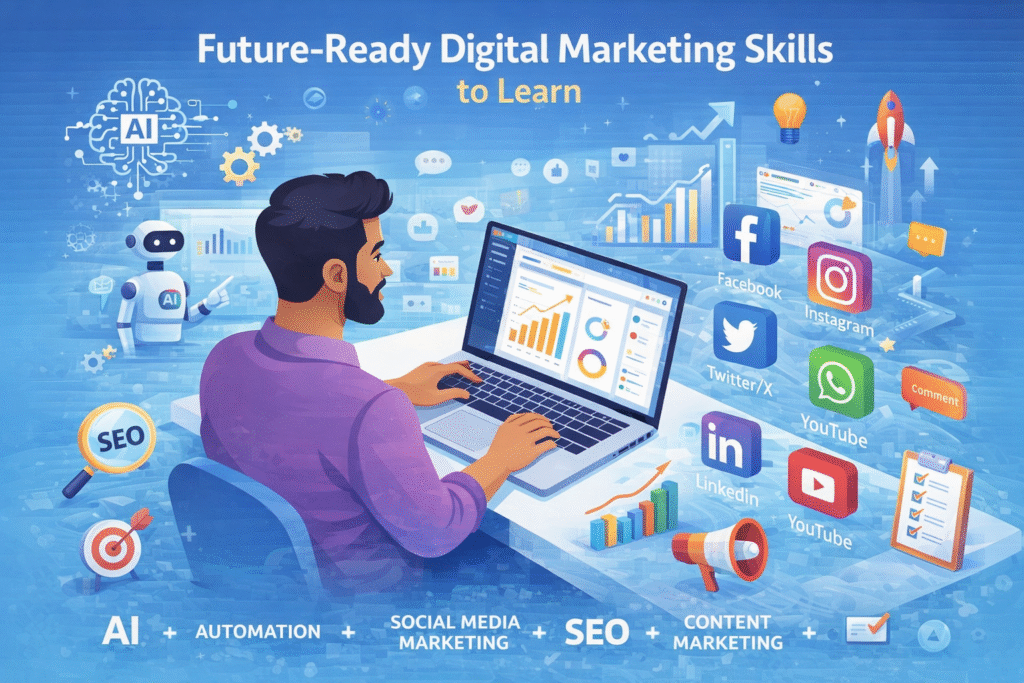
The digital marketing landscape is evolving at an unprecedented pace. What worked yesterday might be obsolete tomorrow, and the marketers who thrive are those who continuously adapt and acquire new skills. As we move deeper into 2026, the intersection of artificial intelligence, automation, and human creativity is reshaping how brands connect with audiences. This comprehensive guide explores the essential digital marketing skills you need to master to stay competitive and relevant in this rapidly changing environment.
Whether you’re searching for the best SEO course in Dwarka Mor, looking for a best social media marketing course near me, or seeking an advanced digital marketing course near me, understanding these future-ready skills will help you make informed decisions about your learning journey. The scope in digital marketing has never been broader, making it the perfect time to invest in your professional development.
The Changing Face of Digital Marketing
Digital marketing has transformed from a niche specialization into the backbone of modern business strategy. The days when knowing how to write a Facebook ad or optimize a website for Google were enough to call yourself a digital marketer are long gone. Today’s digital marketing professionals need to be part technologist, part creative, part analyst, and part strategist.
The rise of AI-powered tools, privacy-focused regulations, and increasingly sophisticated consumers has created a new paradigm. Marketers must now balance automation with personalization, data-driven insights with creative intuition, and broad reach with targeted precision. The professionals who succeed in this environment are those who embrace continuous learning and aren’t afraid to experiment with emerging technologies.
AI-Powered Marketing and Prompt Engineering
Artificial intelligence has moved from buzzword to business necessity in digital marketing. Understanding how to leverage AI tools effectively is no longer optional—it’s fundamental to staying competitive. This is why many professionals are now seeking an AI in digital marketing course to stay ahead of the curve. However, this doesn’t mean AI will replace marketers; rather, it amplifies the capabilities of those who know how to use it properly.
The most critical skill in this domain is prompt engineering. This involves crafting precise instructions that guide AI systems to produce desired outcomes. Whether you’re using AI for content generation, customer service automation, or data analysis, your ability to communicate effectively with these systems determines the quality of results. If you’re looking for the nearest digital marketing institute that offers comprehensive AI training, ensure they cover practical applications of tools like ChatGPT, Claude, and industry-specific AI platforms. Skilled prompt engineers understand how to provide context, specify tone and style, and iterate on outputs to achieve optimal results.
Beyond prompting, modern marketers need to understand AI’s capabilities and limitations. This includes knowing when AI-generated content needs human refinement, recognizing potential biases in automated systems, and understanding how to integrate AI tools into broader marketing workflows. Familiarity with platforms like ChatGPT, Claude, Midjourney, and industry-specific AI tools gives marketers a significant competitive advantage.
The key is viewing AI as a collaborative partner rather than a replacement. The most effective marketers use AI to handle repetitive tasks, generate initial drafts, and analyze large datasets, freeing themselves to focus on strategy, creativity, and relationship building—the distinctly human elements that drive marketing success.
Advanced Data Analytics and Predictive Modeling
Data has always been important in marketing, but the volume, variety, and velocity of data available today require more sophisticated analytical skills. Future-ready marketers need to move beyond basic metrics like page views and click-through rates to understand complex customer journeys, predict future behaviors, and optimize campaigns in real-time.
Predictive analytics allows marketers to forecast customer lifetime value, identify churn risks, and anticipate market trends before they become obvious. This requires comfort with statistical concepts, data visualization tools, and increasingly, machine learning frameworks. While you don’t need a PhD in statistics, understanding concepts like regression analysis, cohort analysis, and attribution modeling is essential.
Tools like Google Analytics 4 represent a shift toward event-based tracking and predictive metrics. Mastering these platforms means understanding how to set up proper data collection, create meaningful segments, and extract actionable insights from complex datasets. Familiarity with visualization tools like Tableau, Looker, or Power BI helps translate data into compelling narratives that drive business decisions.
Privacy regulations have made first-party data collection more valuable than ever. Marketers need skills in building and managing customer data platforms, creating unified customer profiles, and respecting privacy while still delivering personalized experiences. Understanding data governance, consent management, and ethical data practices is now as important as knowing how to analyze the data itself.
The most valuable skill here isn’t just technical prowess—it’s the ability to ask the right questions. Great data analysts know how to identify the metrics that actually matter, spot patterns in noise, and translate findings into strategic recommendations that non-technical stakeholders can understand and act upon.
Video Content Creation and Short-Form Storytelling
Video consumption continues to dominate digital media, and the formats are constantly evolving. While high-production video content still has its place, the explosive growth of short-form video on platforms like TikTok, Instagram Reels, and YouTube Shorts has democratized video marketing. The barrier to entry has never been lower, but standing out requires genuine skill.
Modern video marketing isn’t about expensive equipment—it’s about understanding storytelling, pacing, and platform-specific conventions. Each platform has its own culture, algorithm preferences, and audience expectations. What works on TikTok won’t necessarily translate to LinkedIn, and skilled video marketers understand these nuances.
The technical skills include basic video editing, understanding composition and lighting, audio optimization, and motion graphics. Tools like CapCut, Adobe Premiere, and DaVinci Resolve have become more accessible, but the software is less important than understanding the principles of visual storytelling. How do you hook viewers in the first three seconds? How do you maintain engagement throughout? How do you craft a clear call-to-action without being pushy?
Live video presents another dimension of opportunity. Platforms increasingly prioritize live content, and audiences appreciate the authenticity and immediacy it provides. Comfort presenting on camera, managing real-time interactions, and thinking on your feet are valuable skills that complement pre-produced content.
Beyond creation, marketers need to understand video SEO, thumbnail optimization, and how to analyze video performance metrics. Watch time, completion rates, and engagement patterns tell you what’s resonating with audiences and inform future content strategies.
Marketing and Community Management
The relationship between brands and customers has fundamentally changed. Today’s consumers expect immediate responses, personalized interactions, and genuine relationships with the brands they support. This has elevated conversational marketing and community management from nice-to-have skills to essential competencies. Many professionals enroll in a best social media marketing course near me to master these engagement strategies.
Conversational marketing encompasses chatbots, messaging apps, and real-time customer engagement. Understanding how to design conversational flows, implement chatbot technology, and know when to transition from automated responses to human interaction is crucial. The goal isn’t to trick customers into thinking they’re talking to a human—it’s to provide efficient, helpful experiences that respect their time.
Messaging platforms like WhatsApp Business, Facebook Messenger, and SMS marketing have become powerful channels for direct customer communication. These intimate channels require a different approach than broadcast marketing. You need to balance promotional content with genuine value, respect frequency preferences, and maintain a conversational tone that feels natural rather than scripted.
Community management goes beyond responding to comments. It’s about fostering genuine connections among customers, creating spaces for dialogue, and building brand advocates. This requires emotional intelligence, conflict resolution skills, and the ability to identify and nurture power users who become brand ambassadors.
Social listening—monitoring conversations across platforms to understand sentiment, identify trends, and spot potential issues—has become a specialized skill. Tools can help aggregate mentions, but human judgment is required to interpret context, detect sarcasm, and understand cultural nuances that automated systems miss.
Search Evolution: Beyond Traditional SEO
Search engine optimization has been a cornerstone of digital marketing for decades, but how people search and what search engines deliver is changing dramatically. Voice search, visual search, and AI-powered answer engines are transforming the search landscape, requiring marketers to evolve their approach. If you’re looking for the best SEO course in Dwarka Mor or searching for comprehensive training in West Delhi, make sure the curriculum covers these modern SEO techniques.
Traditional keyword research remains important, but search intent has become paramount. Google’s algorithms increasingly understand context, user intent, and content quality at sophisticated levels. This means marketers need to think beyond keyword density and backlinks to focus on comprehensive topic coverage, expertise demonstration, and genuine user value.
Voice search optimization requires different skills than text-based SEO. Natural language queries are longer and more conversational. Content needs to anticipate how people actually speak, not just what they type. Featured snippets, local SEO, and schema markup become even more critical when optimizing for voice assistants.
Visual search, powered by tools like Google Lens and Pinterest Lens, requires understanding image optimization, alt text strategies, and visual content creation. As cameras become better and AI image recognition improves, the ability to make visual content searchable becomes increasingly valuable.
The emergence of AI-powered search experiences means marketers need to think about how their content gets synthesized and presented by AI systems. This involves structured data implementation, clear information architecture, and creating content that’s both human-readable and machine-understandable.
Technical SEO skills remain crucial. Understanding website architecture, page speed optimization, mobile responsiveness, and Core Web Vitals affects how search engines crawl and rank content. As search algorithms become more sophisticated, technical fundamentals become more important, not less. For those interested in paid search advertising, a comprehensive Google Ads course in West Delhi can complement your organic SEO knowledge and help you master the complete search marketing ecosystem.
Marketing Automation and Integration Management
The modern marketing technology stack is complex, often including dozens of tools that need to work together seamlessly. Understanding marketing automation and how to integrate these systems has become a highly valuable skill. An advanced digital marketing course near me should cover these sophisticated automation strategies and technical integrations.
Marketing automation goes far beyond scheduling social media posts. It encompasses lead nurturing sequences, behavioral triggers, personalized customer journeys, and sophisticated segmentation strategies. Platforms like HubSpot, Marketo, and ActiveCampaign enable marketers to create complex workflows that respond to customer actions in real-time.
The skill lies in strategic thinking—mapping customer journeys, identifying automation opportunities, and balancing efficiency with personalization. Poorly implemented automation feels robotic and damages relationships. Well-executed automation feels thoughtful and enhances customer experiences.
Integration management involves connecting various marketing tools so data flows seamlessly between them. Your email platform needs to talk to your CRM, which needs to connect to your advertising platforms, which need to feed your analytics dashboard. Understanding APIs, webhooks, and integration platforms like Zapier or Make enables marketers to create unified systems rather than disconnected tools.
This technical skill set allows marketers to implement sophisticated attribution models, create unified customer profiles, and maintain data consistency across platforms. It reduces manual work, minimizes errors, and enables more sophisticated marketing strategies that respond to real-time data.
As privacy regulations tighten and third-party cookies disappear, first-party data infrastructure becomes critical. Marketers who can architect systems that collect, unify, and activate customer data while respecting privacy will be invaluable to organizations navigating this transition.
Ethical Marketing and Digital Responsibility
Perhaps the most important emerging skill is ethical marketing practice. As consumers become more aware of data privacy, algorithmic manipulation, and corporate responsibility, marketers must understand the ethical implications of their work and commit to transparent, responsible practices.
This includes understanding privacy regulations like GDPR and emerging frameworks worldwide. It’s not just about legal compliance—it’s about earning and maintaining customer trust. Marketers need to know how to collect data ethically, obtain meaningful consent, and give customers control over their information.
Accessibility is another critical consideration. Creating content that’s accessible to people with disabilities isn’t just the right thing to do—it expands your audience and often improves the experience for everyone. Understanding web accessibility standards, captioning video content, and writing descriptive alt text should be standard practice.
Diversity, equity, and inclusion considerations affect everything from ad targeting to creative representation. Marketers need awareness of potential biases in their work, understanding of different cultural contexts, and commitment to authentic representation rather than tokenism.
Sustainability messaging has become important to consumers, but it must be authentic. “Greenwashing” damages brand credibility faster than almost anything else. Marketers need to honestly communicate their organization’s environmental efforts without exaggeration or misleading claims.
The ability to navigate these ethical considerations while still achieving business objectives is a skill that separates thoughtful professionals from those who chase short-term gains at the expense of long-term trust.
The Path Forward: Continuous Learning
The skills outlined here represent where digital marketing stands today, but the landscape will continue evolving. The most important meta-skill is the commitment to continuous learning. Stay curious, experiment with new platforms and tools, and don’t be afraid to fail and learn from those failures.
Join professional communities, attend industry conferences, take online courses, and most importantly, practice these skills in real-world scenarios. Theory only gets you so far—hands-on experience with these tools and techniques is what truly builds expertise. Whether you choose the nearest digital marketing institute or opt for online learning, ensure the program offers practical, project-based training.
Remember that technical skills are just one part of the equation. Creativity, strategic thinking, empathy, and communication skills remain irreplaceable. The future belongs to marketers who can bridge the gap between technology and humanity, using advanced tools to create authentic connections that drive real business value. The scope in digital marketing continues to expand into new areas like AI integration, metaverse marketing, and privacy-first strategies, making it one of the most dynamic career paths available today.
The digital marketing profession has never been more exciting or full of opportunity. By developing these future-ready skills, you position yourself not just to survive in this evolving landscape, but to thrive and lead the way forward.
Conclusion
Digital marketing’s future is being written now, and the professionals who invest in developing these skills will shape that future. From AI-powered content creation to ethical data practices, from video storytelling to sophisticated automation, the modern marketer’s toolkit has expanded dramatically.
The good news is that resources for learning these skills are more accessible than ever. Online courses, tutorials, free tools, and community forums put professional development within reach of anyone willing to commit the time and effort. Whether you’re searching for the best SEO course in Dwarka Mor, exploring a Google Ads course in West Delhi, or looking for an AI in digital marketing course, the barrier isn’t access to information—it’s the discipline to continuously learn and adapt.
Start with the skills most relevant to your current role or career goals, but don’t ignore areas outside your comfort zone. The most valuable marketers are those who can bridge disciplines—the analyst who understands creative, the content creator who grasps data, the strategist who can implement technology. If you’re exploring the scope in digital marketing, know that professionals with diverse skill sets are the most sought-after in today’s job market.
Ready to Start Your Digital Marketing Journey?
Finding the right training program is crucial for your success. When searching for the nearest digital marketing institute or the best social media marketing course near me, look for programs that offer:
- Hands-on, project-based learning with real campaigns
- Up-to-date curriculum covering AI and emerging technologies
- Certification programs recognized by industry leaders
- Placement assistance and career guidance
- Access to industry-standard tools and platforms
- Small batch sizes for personalized attention
Whether you’re in Dwarka Mor, West Delhi, or anywhere else, investing in an advanced digital marketing course near me is investing in your future. The digital economy isn’t slowing down, and neither should your learning journey. Start today, stay curious, and watch your career transform in this exciting field!