
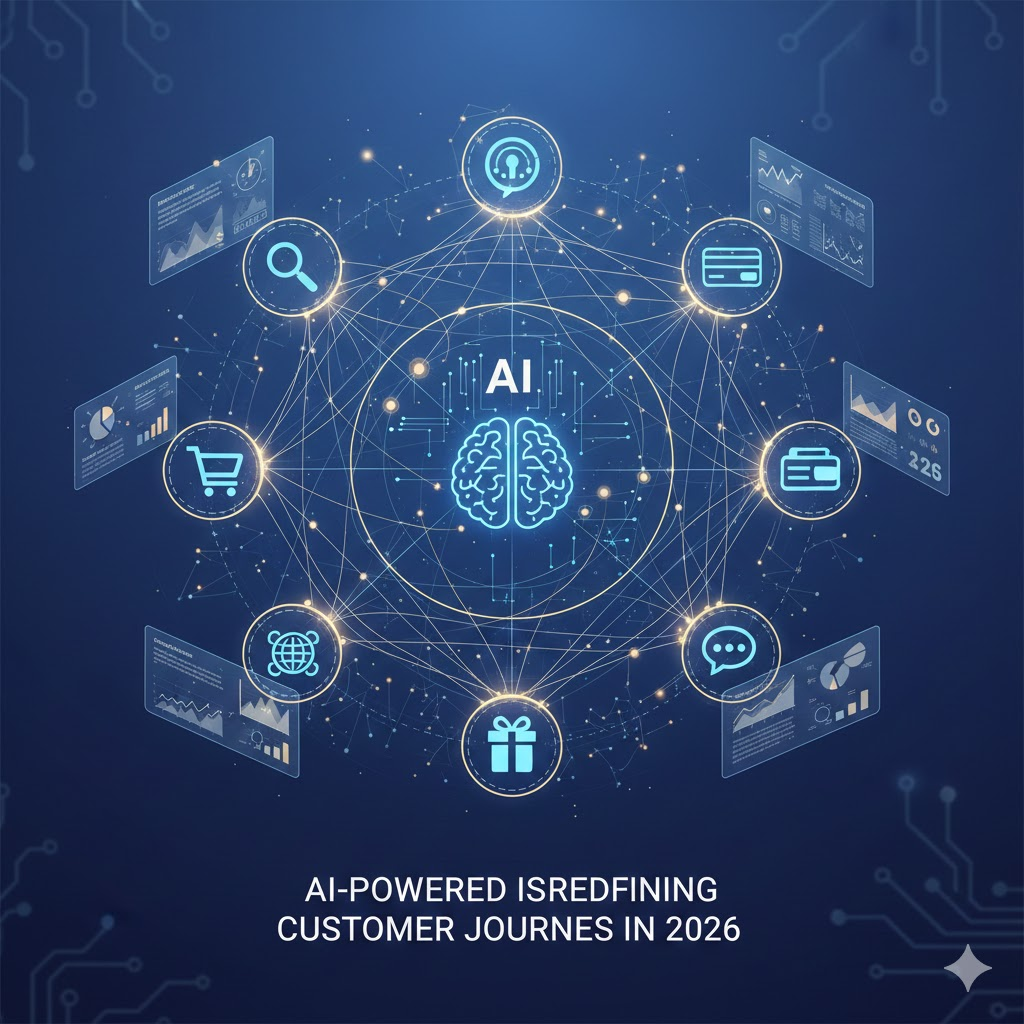
The customer journey has undergone a radical transformation. What once was a linear path from awareness to purchase has evolved into a dynamic, interconnected web of touchpoints, each powered by increasingly sophisticated artificial intelligence. In 2026, AI isn’t just supporting customer experiences—it’s fundamentally redefining how businesses understand, predict, and engage with their customers at every stage of their journey.
As businesses adapt to these AI-driven changes, professionals need to stay ahead of the curve. Understanding these technologies has become crucial for success in modern marketing, which is why institutions like Classify Skill Education are stepping up to offer comprehensive training. From the best digital marketing courses to specialized programs, the scope in digital marketing continues to expand exponentially as AI reshapes customer interactions.
The Evolution of Personalization
Gone are the days when personalization meant simply inserting a customer’s name into an email subject line. Today’s AI systems create truly individualized experiences by analyzing hundreds of data points in real-time, from browsing behavior and purchase history to contextual factors like time of day, device type, and even emotional sentiment derived from interaction patterns.
Modern AI engines build comprehensive customer profiles that evolve with every interaction. These systems don’t just track what customers buy—they understand why they buy, when they’re most likely to engage, and what motivates their decisions. A customer browsing workout equipment at midnight receives different product recommendations and messaging than someone browsing the same category during their lunch break. The AI recognizes these contextual nuances and adjusts accordingly.
What makes this particularly powerful is the shift from reactive to predictive personalization. AI systems now anticipate customer needs before they’re explicitly expressed. If a customer typically reorders a particular product every six weeks, the AI proactively sends a perfectly timed reminder with a streamlined reorder option. If browsing patterns suggest research for a major purchase, the system might offer educational content, comparison tools, or consultation options—all delivered at precisely the right moment.
Conversational Commerce and AI Assistants
Perhaps nowhere is AI’s impact more visible than in conversational interfaces. In 2026, AI-powered chatbots and voice assistants have evolved far beyond simple FAQ responders. They’ve become sophisticated shopping companions capable of understanding context, maintaining conversation continuity, and even detecting emotional undertones that inform their responses.
These AI assistants handle complex, multi-turn conversations with remarkable fluency. A customer can begin a conversation asking about a product category, shift to discussing specific features, request comparisons with alternatives, ask about return policies, and complete a purchase—all within a single, natural conversation flow. The AI maintains context throughout, remembering preferences stated earlier and using them to inform later recommendations.
What’s more impressive is their ability to handle ambiguity and incomplete information. When a customer says, “I need something for my trip next month,” the AI can ask clarifying questions, make informed assumptions based on the customer’s profile and past behavior, and guide them toward relevant options—whether that’s luggage, travel accessories, or destination-specific recommendations.
For marketers looking to master these conversational strategies, enrolling in a social media course in Dwarka Mor or finding the best digital marketing course in Dwarka can provide hands-on training in leveraging AI-powered communication tools that are transforming customer engagement.
Hyper-Targeted Content and Timing
Content delivery has become a precision science. AI systems now determine not just what content to show, but when and how to present it for maximum impact. This goes well beyond basic segmentation—it’s about understanding the micro-moments that matter in each individual’s journey.
Dynamic content generation allows businesses to create thousands of variations of messaging, each optimized for specific customer segments or even individuals. Product descriptions, email copy, website layouts, and even visual elements adapt based on what resonates with each customer. An analytically-minded customer might see detailed specifications and comparison charts, while an emotion-driven buyer receives lifestyle imagery and customer testimonials.
The timing of these touchpoints has become equally sophisticated. AI analyzes patterns to identify optimal engagement windows—those moments when a customer is most receptive to specific types of messages. This might mean sending a promotional email right after someone has engaged with related content on social media, or presenting a special offer when browsing behavior indicates high purchase intent but potential hesitation.
Understanding these AI-driven content strategies requires expertise in search engine optimization and digital marketing fundamentals. Professionals searching for the best SEO institute near me can benefit from comprehensive training that covers both traditional SEO principles and emerging AI technologies that are reshaping how content reaches and engages audiences.
Predictive Customer Service
Customer service has shifted from reactive problem-solving to proactive issue prevention. AI systems monitor customer interactions, product usage patterns, and known issues to identify and address problems before customers even realize they exist.
Imagine ordering a product online and receiving a notification the next day: “We noticed the item you ordered is currently delayed due to supply chain issues. We’ve automatically upgraded your shipping at no cost and applied a discount to your account for the inconvenience.” This isn’t hypothetical—it’s the reality of AI-powered customer service in 2026.
These systems also excel at intelligent routing and triage. When customers do reach out for support, AI analyzes the nature of their inquiry, their emotional state, their value to the business, and the complexity of the issue to route them to the most appropriate resource—whether that’s a self-service solution, an AI assistant, or a human agent with specific expertise. This ensures efficient resolution while optimizing resource allocation.
Seamless Omnichannel Experiences
The boundaries between channels have essentially dissolved. Customers expect to start their journey on one channel and seamlessly continue on another without losing context or repeating information. AI makes this possible by maintaining a unified customer view across all touchpoints.
A customer might begin researching a product on a mobile app during their commute, continue browsing on a desktop computer at work, receive personalized recommendations via email, discuss options with an AI assistant through a smart speaker at home, and complete the purchase in-store—with each interaction informing the next. The AI ensures continuity, remembering preferences, addressing previous questions, and building on earlier interactions regardless of channel.
This orchestration extends to post-purchase experiences as well. Order tracking, support requests, product recommendations, and loyalty rewards flow seamlessly across channels, creating a cohesive experience that feels less like interacting with a company and more like having a dedicated personal assistant.
Ethical Considerations and Transparency
With great personalization power comes significant responsibility. In 2026, leading businesses recognize that customers are increasingly aware of and concerned about how their data is used. The most successful companies have embraced transparency, giving customers meaningful control over their AI-driven experiences.
Progressive privacy controls allow customers to understand what data is being collected, how it’s being used, and what impact it has on their experience. Some businesses offer “AI preference centers” where customers can adjust the level of personalization they receive, opt out of certain data uses, or even view the AI’s reasoning behind specific recommendations.
This transparency extends to algorithmic fairness. Companies are investing in ensuring their AI systems don’t perpetuate biases or create discriminatory experiences. Regular audits, diverse training data, and human oversight help maintain ethical standards while delivering powerful personalization.
The Human Touch in an AI-Driven World
Paradoxically, as AI becomes more prevalent in customer journeys, the value of human interaction has increased. The most effective approaches use AI to handle routine tasks, freeing human agents to focus on complex issues, emotional situations, and relationship building.
Smart businesses recognize that certain moments in the customer journey demand human empathy, creativity, and judgment. AI excels at identifying these moments and facilitating smooth handoffs to human experts. The result is a hybrid model where customers benefit from AI’s efficiency and precision while still accessing human expertise when it matters most.
Preparing for the AI-Driven Future
With the scope in digital marketing expanding rapidly through AI integration, professionals need comprehensive training to stay competitive. Whether you’re looking for the best digital marketing courses or specialized training in specific areas, quality education is essential.
ClassifySkill Education offers industry-leading programs designed to help marketers master AI-driven customer journey strategies. From understanding conversational commerce to implementing predictive analytics, their curriculum covers the full spectrum of modern digital marketing. If you’re searching for the best digital marketing course in Dwarka, a social media course in Dwarka Mor, or the best SEO institute near me, investing in proper training will position you to leverage these powerful AI technologies effectively.
The future belongs to marketers who understand not just the tools, but the strategic thinking behind AI-enhanced customer experiences. The time to upskill is now.
Conclusion
The AI-driven customer journey of 2026 represents a fundamental shift in how businesses and customers interact. Experiences are more personalized, more predictive, and more seamless than ever before. Yet the most successful implementations remember that technology serves the relationship, not the other way around.
As AI capabilities continue to advance, the companies that thrive will be those that use these tools to create genuinely valuable experiences—ones that respect customer autonomy, protect privacy, and enhance rather than replace the human elements that build lasting loyalty. The future of customer journeys isn’t about AI replacing human connection; it’s about AI enabling deeper, more meaningful connections at scale.
The transformation is already here, and it’s redefining not just how we shop or seek support, but how we expect to be understood, anticipated, and valued as customers. In this new landscape, the bar for customer experience has been permanently raised, and there’s no going back to the impersonal, one-size-fits-all approaches of the past.