
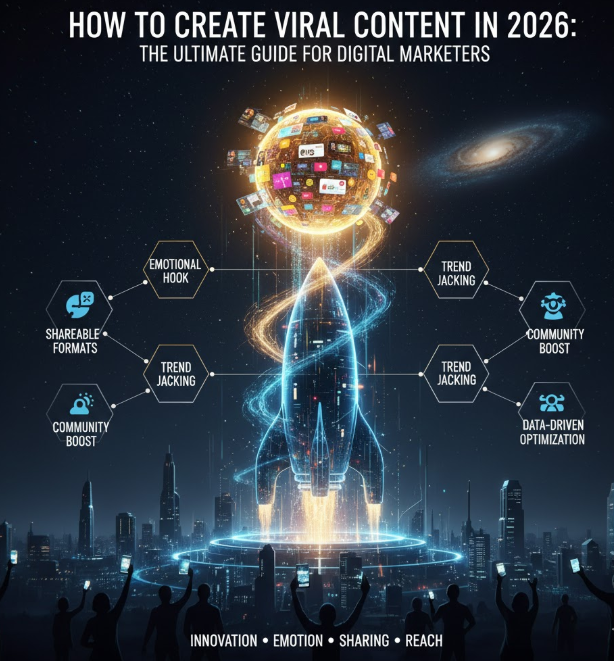
The internet has never been more crowded, more competitive, or more exciting than it is in 2026. Every single day, millions of pieces of content flood social media platforms, blogs, YouTube channels, and podcasts — yet only a tiny fraction of that content ever goes viral. So what separates the posts that get shared ten thousand times from the ones that disappear into the void within hours? The answer lies in understanding human psychology, platform algorithms, and the evolving rules of digital marketing in a world that changes faster than ever before.
Whether you are a brand trying to grow its audience, a content creator looking to build influence, or someone completing a digital marketing internship and eager to prove your skills, this guide will walk you through everything you need to know about creating content that spreads like wildfire in 2026.
Understanding What “Viral” Really Means in 2026
Before diving into the how, it is important to understand the what. Viral content in 2026 does not necessarily mean a video with 100 million views. Virality has become more nuanced. A post that reaches 50,000 people within your niche with a 30% engagement rate is far more powerful than a meme that gets shared mindlessly by millions who forget about it in five minutes. The benefits of digital marketing have always included the ability to measure impact precisely — and in 2026, smart marketers are chasing meaningful virality, not vanity metrics.
Viral content shares a few universal traits: it triggers an emotional response, it is easy to consume and share, it feels timely and relevant, and it offers some kind of value — whether that value is entertainment, information, inspiration, or connection. Keep these four pillars in mind as you build every single piece of content you create.
Know Your Audience at a Deeper Level
The biggest mistake content creators make is creating content they want to make rather than content their audience actually needs. In 2026, audience research has become both easier and more sophisticated. Tools powered by artificial intelligence can now analyze the behavioral patterns of your followers, tell you what topics they engage with most, what time of day they scroll, and even what emotional tone they respond to best.
If you are doing a digital marketing internship, one of the most valuable skills you can develop right now is audience research. Understanding buyer personas, conducting social listening, and analyzing competitor content are all foundational skills that the scope in digital marketing demands from professionals at every level. Spend time in communities where your audience lives — Reddit threads, Discord servers, LinkedIn groups, Instagram comment sections — and listen before you speak.
Craft a Hook That Stops the Scroll
In 2026, the average human attention span when scrolling through a feed is estimated to be under two seconds. That is the window you have to stop someone mid-scroll and compel them to pay attention. Your hook — the first line of your caption, the first frame of your video, the headline of your article — is the single most important element of any piece of content you create.
Great hooks do one of several things: they make a bold or surprising claim, they ask a question that creates instant curiosity, they speak directly to a pain point the audience already has, or they promise a specific result. Weak hooks are vague, generic, and self-centered. Compare “I wanted to share some marketing tips today” with “I used this one content strategy to grow from zero to 100,000 followers in 90 days.” The difference is obvious — and it is the difference between someone scrolling past and someone stopping to read every word.
Leverage Short-Form Video — But with a Strategy
Short-form video remains the dominant content format in 2026. Platforms like Instagram Reels, TikTok, and YouTube Shorts continue to receive massive algorithmic boosts compared to other content types. But simply posting short videos is not enough anymore. The market is saturated. What works now is combining strong storytelling with visual clarity, authentic personality, and strategic keyword use within captions and voiceovers.
This is one of the most talked-about areas within the scope in digital marketing today. Brands and agencies are actively hiring people who understand video content strategy — from scripting and editing to caption optimization and trend analysis. If you are in a digital marketing internship, pitch your team on a short-form video series, execute it, and track the data. The results will speak louder than anything on your resume.
The benefits of digital marketing become most visible in video campaigns. You can A/B test thumbnails, measure watch time down to the second, and retarget viewers who watched more than 50% of your video with a follow-up ad or piece of content. This level of precision is impossible in traditional marketing and is what makes digital the most powerful channel available today.
Emotion Is the Algorithm
Here is something the most successful content creators in the world understand that most beginners do not: algorithms do not promote content randomly. They promote content that keeps people on the platform. And what keeps people on the platform is emotion. Joy, surprise, anger, awe, nostalgia, and inspiration are all emotions that drive people to engage — to comment, share, save, and come back for more.
When you are planning content, ask yourself: what emotion does this piece trigger? If the honest answer is “none,” go back to the drawing board. Content that informs without emotion is a textbook. Content that informs and inspires is viral material. Think about how you can wrap even the driest information inside a compelling story or a relatable moment. A statistic about email open rates is boring. A story about how one email campaign saved a struggling small business is something people share with their colleagues.
Consistency Beats Virality Every Time
This might sound counterintuitive in a guide about going viral, but the truth is that chasing one-hit virality is a losing game. The creators and brands that consistently grow their audiences are the ones that show up with valuable, authentic content day after day, week after week. Virality is often a byproduct of consistency rather than a goal in itself.
The scope in digital marketing has expanded enormously in recent years precisely because brands have realized that building a loyal digital audience requires sustained effort, strategic thinking, and skilled execution. This is why companies are investing heavily in content teams, social media managers, SEO specialists, and data analysts. The benefits of digital marketing — including global reach, cost efficiency, real-time data, and highly targeted campaigns — are only realized by those who commit to a long-term strategy.
SEO and Social Media Are No Longer Separate
In 2026, search engine optimization and social media strategy have converged in ways that marketers could not have predicted just a few years ago. Instagram, TikTok, and even LinkedIn now function as search engines. People type in questions and keywords to find content, not just people. This means that your captions, hashtags, alt text, and video voiceovers need to be optimized with searchable keywords — the same way a blog post would be optimized for Google.
If you are in a digital marketing internship, mastering this intersection is an incredibly valuable skill. Learn how to do keyword research using tools like SEMrush, Ahrefs, or Google Keyword Planner, and then apply those learnings not just to written content but to your entire content ecosystem. Brands that understand how to be discoverable across every platform simultaneously are the ones winning in 2026.
Collaboration and Community Building Are the New Growth Hacks
One of the most reliable ways to create viral content in 2026 is through collaboration. When two creators or brands with complementary audiences create content together, both sides benefit from exposure to an entirely new group of engaged followers. This is not a new concept, but the sophistication with which it is being executed has reached a new level.
Beyond collaboration, community building is where the real long-term magic happens. Creators who build genuine communities — through newsletters, Discord servers, exclusive content, or even consistent comment engagement — have audiences that actively advocate for them. These communities become amplification engines. When you drop a new piece of content, your community is the first to share it, and that early wave of engagement signals to the algorithm that your content is worth promoting to a wider audience.
Final Thoughts: Digital Marketing Is the Future — And the Future Is Now
Creating viral content in 2026 is equal parts science and art. It requires understanding data and emotion, strategy and spontaneity, consistency and creativity. The good news is that the tools, platforms, and knowledge needed to succeed have never been more accessible.
The scope in digital marketing has never been broader. From content creation and SEO to paid advertising, analytics, influencer marketing, and AI-driven automation, there are dozens of career paths available for those willing to develop their skills. The benefits of digital marketing — measurable results, global reach, and the ability to connect with your exact target audience — make it the most powerful marketing discipline in existence.
Whether you are a student, a professional, or someone completing a digital marketing internship, the skills you develop in this field today will compound in value for years to come. Study the platforms, understand the psychology, create with intention — and do not be afraid to experiment. The next piece of viral content could be yours.
Keywords: How to Create Viral Content 2026, digital marketing internship, scope in digital marketing, benefits of digital marketing, viral content strategy, short-form video marketing, social media growth, content marketing tips, digital marketing career