
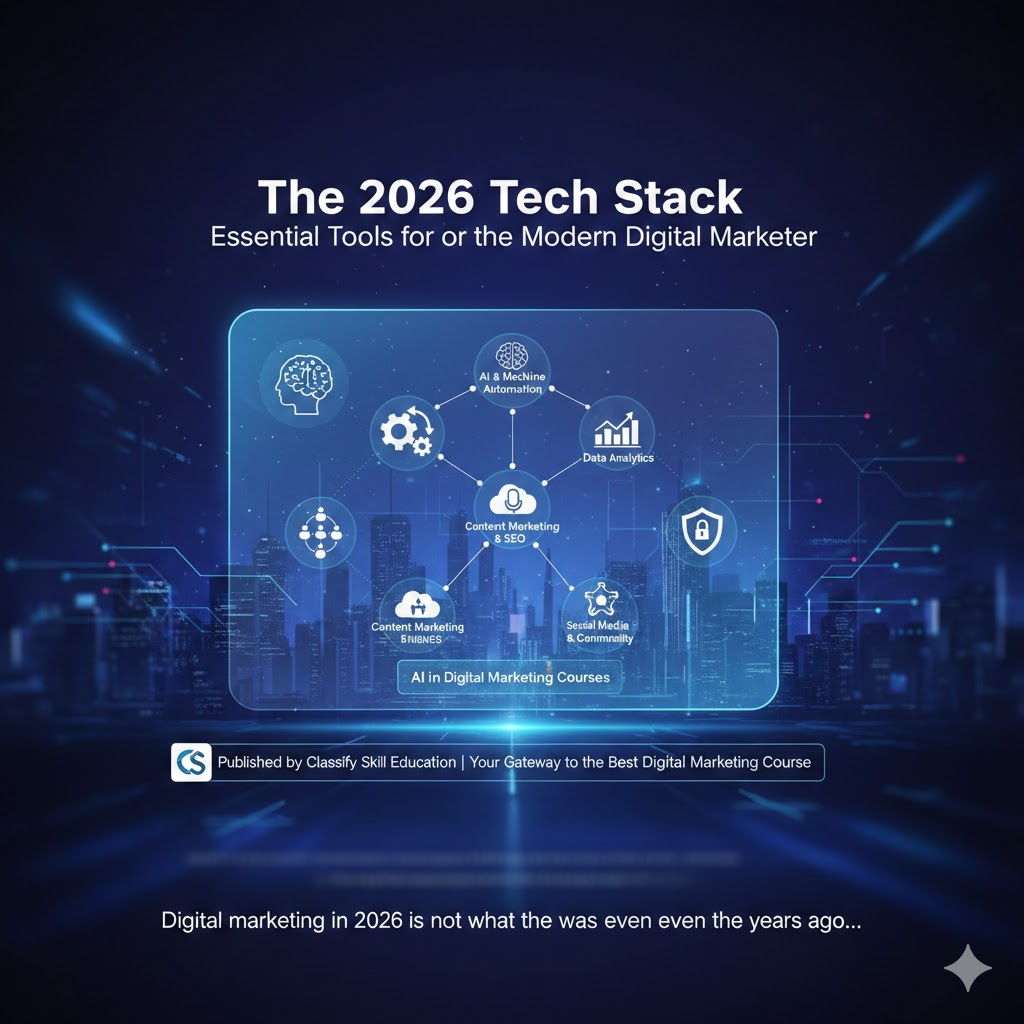
Published by Classify Skill Education | Your Gateway to the Best Digital Marketing Course
Digital marketing in 2026 is not what it was even two years ago. The landscape has shifted dramatically — artificial intelligence is no longer a buzzword but a backbone, automation has replaced repetitive tasks, and data-driven storytelling has become the single most valuable skill a marketer can possess. Whether you are just entering the field or looking to level up your expertise through an advanced digital marketing course, staying current with the right tools isn’t optional — it’s survival.
This blog breaks down the essential tech stack every modern digital marketer needs in 2026, and why investing in the right education, particularly through AI in digital marketing courses, puts you miles ahead of the competition.
Why Your Tech Stack Defines Your Marketing Success
Before we dive into individual tools, let’s talk about something fundamental: the marketer’s tech stack is their toolkit, and just like a carpenter with outdated tools, a marketer working with yesterday’s software will produce yesterday’s results.
The best professionals in the industry — those who land roles at top agencies and fast-growing startups — are not just creative thinkers. They are technically fluent. They understand how platforms interact, how data flows between systems, and how to leverage automation without losing the human touch. This kind of fluency comes from structured learning, which is why choosing the best digital marketing institute in Dwarka Mor or your local area can make a tangible difference in how quickly you develop these competencies.
Now, let’s get into the tools themselves.
1. AI-Powered Content Creation & Strategy Tools
The content game has been completely transformed by artificial intelligence. In 2026, AI tools are not writing content for marketers — they are writing with them. The distinction matters.
Tools like Jasper AI, Copy.ai, Notion AI, and Claude are embedded into content workflows to help marketers brainstorm, draft, edit, and optimize at scale. Instead of spending hours on a single blog post, a skilled marketer can now produce multiple high-quality pieces per day — provided they know how to prompt, direct, and refine AI outputs effectively.
This is exactly the kind of skill taught in a quality AI in digital marketing course. You learn not just to use these tools, but to use them strategically — matching the right tool to the right task, maintaining brand voice, and blending automation with authentic storytelling.
Key tools in this category for 2026:
- Jasper AI – Long-form content and campaign copy
- Surfer SEO + AI – Content briefs and real-time optimization
- Claude / ChatGPT – Research, ideation, and repurposing
- Canva AI – Visual content generation with text-to-design features
2. SEO & Search Intelligence Platforms
Search engine optimization has evolved from keyword stuffing to intent mapping. Google’s algorithms in 2026 reward depth, authority, expertise, and user satisfaction — and the tools that help you achieve all four have become incredibly sophisticated.
Semrush, Ahrefs, and Moz remain industry staples, but in 2026 they’ve integrated predictive AI features that can forecast keyword trends before they peak. Google Search Console paired with Looker Studio (formerly Google Data Studio) gives marketers real-time performance dashboards that used to require a dedicated data analyst to build.
For local businesses and digital marketing institutes, local SEO tools like BrightLocal and Whitespark are essential for ranking in hyper-local searches — think “best digital marketing course” near me” or “advanced digital marketing course near me” — exactly the searches potential students use when looking for training options. Ki
Understanding how these tools work, how to interpret the data, and how to translate insights into action is one of the most valuable competencies covered in structured digital marketing training programs.
3. Marketing Automation & CRM Integration
The days of manually sending emails, following up on leads, and tracking customer journeys through spreadsheets are well behind us. In 2026, marketing automation is not just about scheduling emails — it’s about building intelligent, behavior-triggered ecosystems that nurture leads from awareness to conversion without constant manual intervention.
HubSpot continues to dominate as an all-in-one CRM and marketing automation platform, but tools like ActiveCampaign, Klaviyo (especially for eCommerce), and Brevo (formerly Sendinblue) offer powerful alternatives depending on your niche and budget.
What makes 2026’s automation tools special is their integration with AI. These platforms can now:
- Predict the best time to send an email based on individual user behavior
- Dynamically personalize email content based on CRM data
- Score leads automatically and route them to sales teams at the right moment
- Generate A/B test variations using built-in AI copy features
This is a significant area covered in advanced digital marketing courses — understanding how to architect automation workflows, segment audiences intelligently, and measure the ROI of every automated touchpoint.
4. Social Media Management & Analytics Tools
Social media marketing in 2026 goes far beyond posting consistently. Platforms have become pay-to-play environments where organic reach is limited, and the marketers who win are those who combine organic creativity with paid precision.
Meta Business Suite, LinkedIn Campaign Manager, and TikTok Ads Manager form the holy trinity of paid social in 2026. On the organic and management side, tools like Buffer, Hootsuite, and Sprout Social remain go-to platforms for scheduling, monitoring, and analyzing social performance.
What’s changed dramatically is the role of AI in creative production. Tools like Opus Clip and Descript use AI to automatically transform long-form videos into short-form clips optimized for Reels and Shorts. Predis.ai can generate entire social media posts — image, caption, and hashtags — from a single product description.
For anyone pursuing the best digital marketing course, understanding how to use these tools in an integrated social strategy is non-negotiable. Employers want marketers who can manage end-to-end campaigns, not just post pretty pictures.
5. Paid Advertising & Performance Marketing Platforms
Performance marketing is where digital strategy meets real money — and in 2026, the platforms running paid ads have become both more powerful and more demanding in terms of the expertise required to use them profitably.
Google Ads and Meta Ads remain the dominant paid channels. But in 2026, both platforms are heavily AI-assisted through features like Performance Max (PMax) campaigns on Google and Advantage+ Shopping Campaigns on Meta. These tools use machine learning to optimize targeting, creative, bidding, and placement automatically — but they still require skilled marketers to set up correctly, feed with the right data, and interpret meaningfully.
Microsoft Advertising (Bing Ads), Pinterest Ads, and YouTube Ads round out the paid media landscape for most businesses. Programmatic advertising platforms like The Trade Desk are increasingly accessible for mid-market brands.
Learning to run profitable paid campaigns across multiple channels is a core component of any serious advanced digital marketing course. It requires understanding audience psychology, creative strategy, conversion tracking, and budget management simultaneously — skills that take hands-on practice to develop.
6. Analytics, Data Visualization & Reporting
If you can’t measure it, you can’t improve it. In 2026, analytics has moved from a nice-to-have to a core marketing competency. The modern digital marketer is expected to be comfortable with data — pulling it, interpreting it, and presenting it clearly to stakeholders.
Google Analytics 4 (GA4) is now the universal standard for web analytics. Combined with Google Tag Manager for event tracking and Looker Studio for visual reporting, this trio forms the analytical backbone of most digital marketing operations.
For more advanced use cases, tools like Mixpanel and Amplitude offer event-based analytics built specifically for product-led growth strategies. Hotjar and Microsoft Clarity provide behavioral analytics — heatmaps, session recordings, and funnel analysis — that show not just what users are doing but why.
Data literacy is one area where many marketers fall short, and it’s one area where studying at the best digital marketing institute in Dwarka Mor or a similarly reputable institution can give you a real competitive advantage. Courses that include hands-on GA4 training, dashboard building, and data storytelling prepare you for the real demands of marketing roles in 2026.
7. AI Tools for Email Marketing & Personalization
Email marketing remains one of the highest-ROI channels in digital marketing, and in 2026 it has been completely reinvented by personalization at scale.
Platforms like Klaviyo, Mailchimp, and ActiveCampaign now feature built-in AI that can:
- Write subject line variations and predict open rates
- Personalize email body content based on user behavior
- Determine optimal send times for each individual subscriber
- Automatically re-engage lapsed subscribers with the right message
For eCommerce marketers especially, AI-powered email flows — abandoned cart sequences, post-purchase nurtures, win-back campaigns — can generate revenue passively once set up correctly.
Understanding how to design these flows, write high-converting copy, and interpret performance metrics is a skill covered comprehensively in the best digital marketing course programs that keep their curriculum current.
8. Conversion Rate Optimization (CRO) Tools
Driving traffic is half the battle. Converting that traffic is where the real money is made. CRO tools help marketers identify friction points on websites and landing pages and test solutions systematically.
Unbounce and Leadpages remain leading landing page builders with built-in A/B testing. VWO (Visual Website Optimizer) and Optimizely are powerful enterprise-grade experimentation platforms. Hotjar bridges analytics and CRO with its heatmapping and feedback tools.
In 2026, AI-powered CRO tools like Intellimize can run multivariate tests automatically, learning which page variants perform best for different audience segments in real time — dramatically accelerating the traditional testing cycle.
The Human Advantage: Why Learning Still Matters
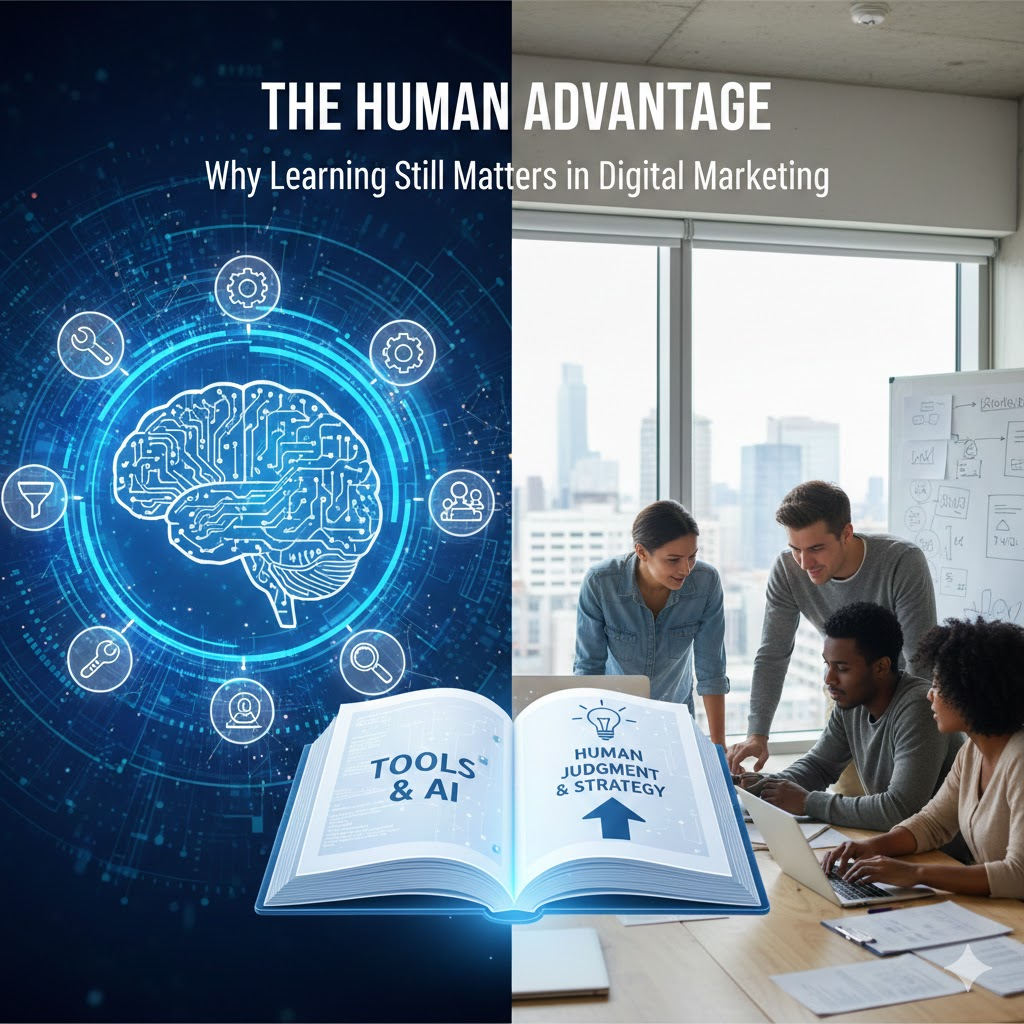
With all these tools available, it might be tempting to assume that anyone can become a digital marketer simply by subscribing to the right software. But that thinking misses something crucial.
Tools are only as powerful as the person using them. Understanding why a campaign underperformed, how to design a funnel that converts, when to use paid media versus organic content, what metrics actually indicate business impact — these are judgment skills that come from education, mentorship, and practice.
This is why institutes focused on AI in digital marketing courses — programs that don’t just teach tools but teach marketing thinking — are more valuable than ever. The best digital marketing course programs combine technical tool training with strategic frameworks, live campaign experience, and portfolio building that employers actually care about.
How Classify Skill Education Prepares You for 2026
At Classify Skill Education, the curriculum is built around the real demands of digital marketing in 2026. The program covers every layer of the modern tech stack — from AI-powered content tools and Google Ads, to GA4 analytics, marketing automation, and social media strategy — with hands-on projects on each platform.
Whether you’re searching for an advanced digital marketing course near me or the best digital marketing institute in Dwarka Mor, Classify Skill Education brings together expert instructors, live campaign exposure, and placement support designed to get you job-ready, not just certificate-ready.
The institute’s AI in digital marketing course is particularly ahead of the curve, teaching students how to integrate AI tools ethically and effectively into real marketing workflows — the exact skill set that agencies and brands are hiring for right now.
Conclusion:
The 2026 tech stack is not a list of tools to memorize. It is an ecosystem to understand. The marketers who thrive are those who see how each tool connects to the others, who can adapt as platforms evolve, and who combine technical fluency with creative and strategic thinking.
Investing in structured education — through the best digital marketing course available to you — is the single highest-ROI decision you can make at the start of or during your marketing career. Because while tools change, the ability to learn, adapt, and apply knowledge is what creates lasting professional value.
Start with the right foundation. Build with the right tools. Grow with the right skills.