
Marketing That Only Pays for Results Sounds Too Good to Be True, Right?
Most businesses have spent heavily on advertisements and seen that money vanish without any measurable return. Here’s a Facebook ad, there’s a banner campaign. Traffic arrives, but conversions don’t.
That frustration is precisely what performance marketing was designed to address.
Unlike traditional advertising, where you pay upfront and hope for the best, performance marketing reverses the approach. You only pay when something actually occurs. A click. A leading position. A sale. A registration. The results precede the payment.
It may seem straightforward, but there’s considerable depth to it. Let’s break it down in a way that actually makes sense.
So What Exactly Is Performance Marketing?
Performance marketing is a form of digital advertising in which you are charged according to particular actions taken, rather than merely for views or exposure.
Consider it from this perspective. With a traditional billboard, you pay for exposure regardless of whether viewers are interested in your product. In performance marketing, you only pay when a user clicks your ad, completes a form, makes a purchase, or performs any other action you’ve designated as valuable.
This positions it as one of the most cost-effective and trackable marketing methods available today.
The crucial term here is measurable. Every rupee you spend is monitored. You’re fully aware of where it went, what it did, and whether it was effective.
How Does Performance Marketing Actually Work?
Let us walk through the basic flow so it clicks for you.
A brand wants to generate leads for a new product. They run a performance marketing campaign using Google Ads or Meta Ads. They set a goal, say, getting people to fill out a contact form.
Now here is what happens step by step:
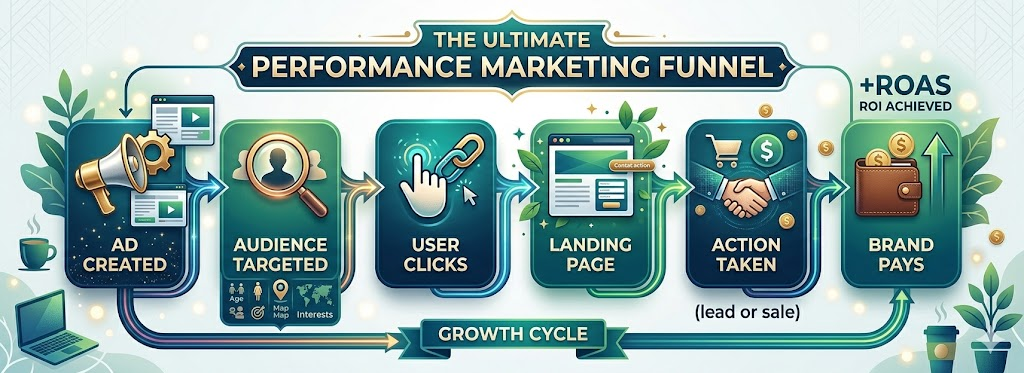
• The brand creates an ad targeting a specific audience based on age, location, interest, or search behavior
• The ad appears on Google, Instagram, Facebook, or partner websites
• A user sees the ad and clicks on it
• They land on a dedicated page designed to convert them into a lead or customer
• If they complete the action, that counts as a conversion
• The brand pays for that conversion, not just for showing the ad
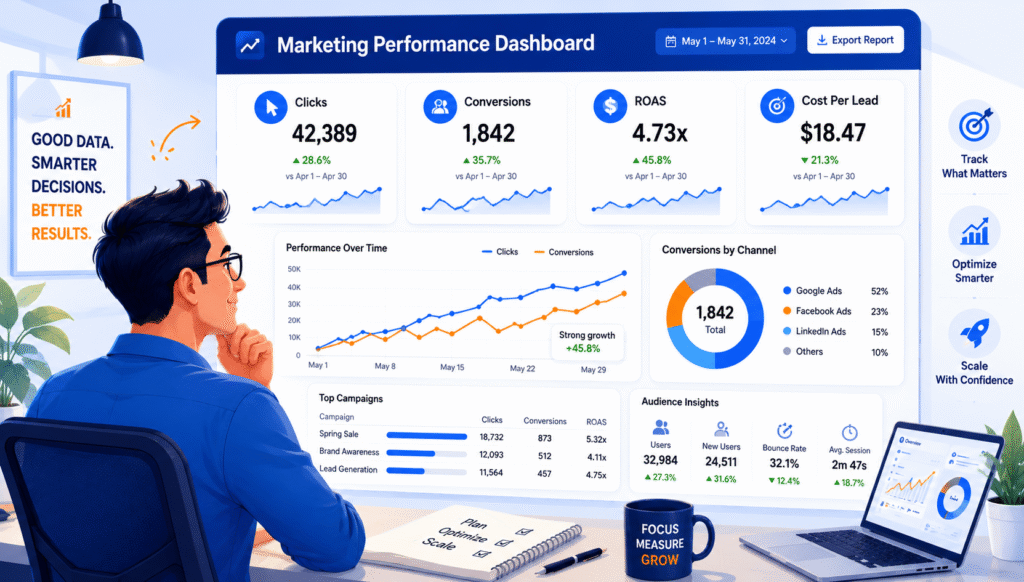
The whole process is tracked using pixels, analytics tools, and campaign dashboards. You can see in real time what is working and what is not. You can stop what is wasting money and double down on what is bringing results.
Where Does Performance Marketing Happen?
Performance marketing is not limited to one platform. It runs across a range of channels, each with its own strength.
• Google Search Ads: Appear when people search for something specific. Great for capturing high-intent buyers
• Meta Ads (Facebook and Instagram): Reach people based on interests and behavior. Strong for awareness and lead generation
• Affiliate Marketing: Partner websites or creators promote your product and earn a commission on each sale they drive
• Native Advertising: Paid content that blends into the platform it appears on, like Taboola or Outbrain
• Display and Retargeting Ads: Banner ads shown to people who have already visited your website, reminding them to come back
Each channel works differently but they all share the same core idea. You define a goal, track the results, and pay for what actually happens.
The Metrics That Actually Matter
One of the biggest reasons marketers love performance marketing is the clarity it brings. You are never guessing. You are reading numbers.
Here are the metrics you will work with most often:
• CPC (Cost Per Click): How much you pay each time someone clicks your ad
• CPL (Cost Per Lead): How much it costs to get one person to submit their details
• CPA (Cost Per Acquisition): The total cost of getting one paying customer
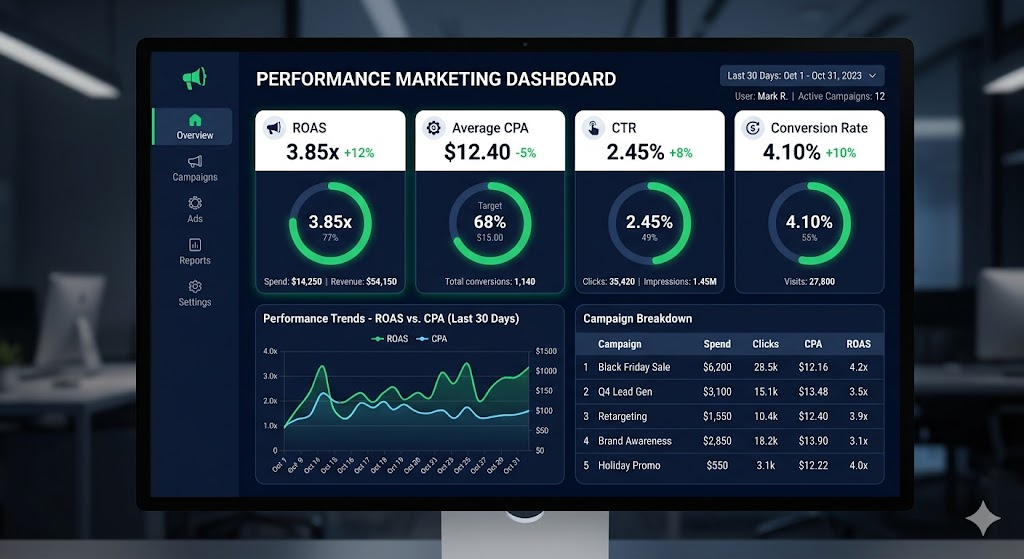
• ROAS (Return on Ad Spend): How much revenue you earn for every rupee spent on ads
• CTR (Click-Through Rate): The percentage of people who see your ad and actually click it
• Conversion Rate: How many of the people who land on your page complete the action you want
When you understand these numbers and know how to improve them, you become extremely valuable to any business running paid campaigns.
Who Should Learn Performance Marketing?
Frankly, many people can gain from mastering this skill.
• Fresh graduates seeking a high-demand , well-paying career in digital marketing
• Business owners aiming to manage their own campaigns without relying on agencies
• Marketing professionals looking to enhance their profiles with paid media expertise
• Freelancers wanting to deliver high-value services to clients
• Anyone interested in understanding how online ads function behind the scenes
The best part? You do n’t need a technical background to get started. The tools are designed for ease of use. What you really need is a readiness to grasp data and keep testing things regularly.
If you ’re based in Delhi and seek hands-on, structured training, enrolling in a performance marketing course in Dwarka Mor will provide you with the practical experience that employers and clients value.
Conclusion
Performance marketing is not a passing fad. It serves as the basis for how most serious businesses promote themselves online today. It can be measured, expanded, and trusted. You invest money, observe outcomes, and make adjustments using actual data.
For anyone considering a career in digital marketing, mastering performance marketing is now essential. It ranks among the most valuable skills you can possess by 2026.
Whether your goal is to join a top agency, run campaigns for a brand, or launch your own freelance business, enrolling in a strong performance marketing course in Dwarka Mor any reputable training program gives you a genuine advantage.
Begin learning, begin testing, and let the data steer you. That’s precisely what performance marketing is focused on.
Frequently Asked Questions (FAQs)
Here are five questions people genuinely search for when they want to learn more about performance marketing.
Q1. What is the difference between performance marketing and digital marketing?
Ans. Digital marketing is a broad term that covers everything from SEO and social media to content and email marketing. Performance marketing is a specific type within digital marketing where you only pay when a defined action happens, like a click, lead, or sale. Think of performance marketing as a results-first subset of digital marketing.
Q2. Is performance marketing a good career in India in 2026?
Ans. Yes, it is one of the fastest-growing career paths in digital marketing right now. Companies are spending more on paid advertising every year and they need skilled performance marketers who can manage campaigns efficiently. Starting salaries range from 2.5 LPA to 3.5 LPA and grow quickly with experience. Specialists in Google Ads or Meta Ads often earn significantly more.
Q3. How long does it take to learn performance marketing?
Ans. You can grasp the basics of performance marketing in four to eight weeks with focused learning. Getting fully job-ready with hands-on campaign experience typically takes three to six months. The learning does not stop there though. Performance marketing evolves constantly, so the best professionals keep testing and updating their knowledge regularly.
Q4. What tools do performance marketers use every day?
Ans. Performance marketers work with tools like Google Ads, Meta Ads Manager, Google Analytics 4, Google Tag Manager, Semrush, and Canva for creatives. Most campaigns also rely on tracking pixels, UTM parameters, and CRM software to monitor results. A good performance marketing course will teach you how to use all of these in a practical setting.
Q5. Can I learn performance marketing without any prior experience?
Ans. Absolutely. Many successful performance marketers started with zero background in marketing or advertising. What matters is your willingness to understand numbers, run experiments, and learn from results. Free resources from Google Skillshop and Meta Blueprint are great starting points. For a more structured and faster path, a performance marketing course in dwarka mor or a similar hands-on program can get you job-ready in a few months.